Showing posts with label DEY-5. Show all posts

Monday, September 6, 2021

Switcher Paint Schemes

As I've been researching the DEY-3 (Alco S-1) and DEY-5 (S-2) locomotives, I started compiling the info on paint schemes for these locomotives. 


Since there have been a few questions over the last year about the evolution of the paint schemes, I decided to create a spreadsheet with all of the paint schemes I have verified and decided to expand it to cover the life of all NH diesel switchers. A lot of the info was found in the excellent article by Marc J. Frattasio and Bill Chapin on the DEY-3 and DEY-5 switchers in Shoreliner 35.1, plus Marc's extremely thorough book on the NH, The New Haven Railroad in the McGinnis Era along with photos and official NH documents.


DEY-3 (S-1) 0967 at New Britain, December 1, 1961. J. W. Swanberg.

Through 1945, all diesel switchers wore Pullman Green with Imitation Gold Duco (not Dulux) lettering. Starting in 1946, there are no fewer than 10 paint schemes, not including minor variations, applied over about a 15 year period until the final Alpert-era scheme was first applied c1961. Road switchers carried similar, if not identical, schemes during the same periods. 


Locomotives were repainted as needed, so no locomotive wore all 10 of these schemes. It appears that most wore two to three different schemes over their lifetime.


Where known it includes the date applied. If a photo has surfaced that is within the period that a given scheme was applied, it is noted as "by (date)."


For the 401 green scheme, I have painting info up to January, 1955. I've seen a photo of 0994 in that scheme from September 1, 1955. So it had to have received the scheme between January and September of 1955. For all other schemes, the range would be from the date of adoption and the date of the photo.


Light gray cells indicate a given locomotive never wore that scheme.


Light green cells indicate that the prior paint scheme has been verified through a given period, often until the end of the NH. In most cases, the latest scheme noted was the final scheme worn. The light green shading designates those I could verify. I've included disposition dates so you can see when a locomotive was no longer in use.


I haven't dug through all of the Shoreliners, books, and other resources I have, but I will continue to update the spreadsheet as I find more info/photos. Of course, I welcome input for updates from other documentation or dated photos.


Pullman Green with Imitation Gold Duco

DEY-3 (S-1) 0967 at Wethersfield in May, 1949. John Wallace.

This was the standard diesel switcher scheme starting with the delivery of 0900 in 1931 through 1945. The cab and hood are Pullman Green and lettering Imitation Gold Duco.  The frame on most is black, but some (such as the 44-tonners) it was also Pullman Green.


There are several locomotives that appear to still be in this scheme through January, 1955, or until they were sold in the case of a few locomotives that were off the roster before that: 0607, 0613, 0803, 0804, 0805, 0806, 0808, 0941, and 0964.


Green (Pullman?) cab with Warm Orange Hood

January, 1946

Hunter Green cab with Warm Orange Hood

June 26, 1947


DERS-2b (RS-2) 0509 at Pittsfield. Sweetland.


This is the first Green and Orange scheme for switchers and road switchers. It consisted of a Hunter Green cab and 90 degree fillets at the base of the cab, with Warm Orange hoods and lettering. On the switchers, the back of the cab was also Warm Orange.


The initial scheme in 1946 does not specify the color green, but the June 26 drawing indicates the color was changed to Hunter Green. It's believed the initial color may have been Pullman Green. Only a few locomotives (0933, 0939, and 0947) have been identified to have been painted prior to the June 26 update.


In addition to the post-war DEY-3 class (0971-0995) (the first switchers delivered with the Warm Orange hoods) and the final two DEY-4 locomotives (0817-0818), the Hunter Green/Warm Orange scheme was the delivery scheme for the DERS-1b (RS-1) and DERS-2b (RS-2) locomotives as well.


Pullman Green cab with Warm Orange Hood

May 19, 1950

DEY-4 (44-tonner) 0813. Date and location unknown.

Three years later, the scheme was altered by replacing Hunter Green with Pullman Green. It is otherwise identical.


Pullman Green Cab, top of hood, and Warm Orange

June 5, 1951

DEY-4 (44-tonner) 0807. Date and location unknown.

About a year later the scheme was modified to match the delivery scheme of the second and third deliveries of the DERS-2c (RS-3) locomotives. In addition to the Pullman Green Cab, there is a band of Pullman green at the base of the hood, still with the 90 degree fillet, and the hood top is also Pullman Green. Note that there is no fillet at the top of the hood where it meets the cab. 


401 Green Hood, top of hood, and Warm Orange

May 6, 1954 (October, 1953)


DEY-5 (S-2) 0617 at Worcester engine house, May 21, 1956. Ed Ozog.

Also known as the "full balloon" or "hot dog" scheme, a 90 degree fillet is added to create a full 180 degree curve at the end of the Warm Orange in front of the cab. In addition, the green has changed to 401 Green. 

The surviving diagram of this scheme indicates that it is a correction as of May 6, 1954. Photographic evidence cross-referenced with NH documentation indicates it was first applied in October of 1953. I don't believe this scheme was ever applied to the DEY-4 (44-tonner) locomotives.

--

Onto the Matter-designed McGinnis and later schemes, well beyond my modeling era so I don't have nearly as much information for you. In particular I have far fewer photos of equipment in these schemes.

Matter/McGinnis with White Sill

DEY-1, June 15, 1955

DEY-7, January, 1956

DEY-3, May 24, 1957


DEY-3 (S-1) 0993 and 0995 at Charles St., Providence, September 14, 1957. David Sweetland.
This shows both the Red Sill and White Sill Matter/McGinnis variations.

This scheme was first used on the DEY-1 classes and was also the delivery scheme for the DEY-7 locomotives. On May 24, 1957 the diagram for the DEY-3 switchers was updated to this scheme.


It has a Red Orange cab, hood end and top, and railings, with white side sills and a white "NH" centered on the hood. The cab roof and hood were black.


Matter/McGinnis Red Orange Sill

DEY-3, -5, February 1, 1956


This design, the original one applied to DEY-3 and -5 classes, had a black hood with no Red Orange top, seen on the DEY-5 (S-2) in the photo above, It also had Red Orange cab ends, hood end, side sills, and hand rails with a large white "NH" next to the radiator shutters. 


Matter/McGinnis with Black Sill

DEY-1, -3, August 2, 1957

DEY-1b (HH660) at Boston Freight Terminal. Date and photographer unknown.


Other than the black side sills, this variation is identical to the White Sill scheme and was also only used on the DEY-1/1b/3 switchers. For the DEY-1 classes it appears that many originally had the white sills, which were then painted over with black.


Note that in the photo of 0924 above, the Red Orange is a much "redder" shade. This appears to be the case on the majority of the photos of the black sill variation. This may not have been noted on the painting & lettering diagrams because c1956/7 there was a switch the paint formulation, but both were called "Red Orange" although I don't know if the No. 406 Orange Red was used on any switchers.


New Haven Color Guide (available from NHRHTA) has a number of Red Orange color chips:

  • No. 428 Red Orange. (1955-1956) Often called "Socony Red" by modelers.
  • No. 409 Red Orange (1956-1964) Used on 1956 road switchers and locomotive repaints.
  • No. 406 Orange Red (early) (1957-c1960) Used on first 30 FL-9s and locomotive repaints.

1956 Road Switcher Scheme

March 24, 1958

DEY-4 (44-tonner) 0818. Date, location, and photographer unknown.

This is a classic scheme that is often referred to as The McGinnis scheme, It has a Red Orange cab, with everything else black, and a Red Orange "N" over a white "H" centered on the hood. Although I've never been a fan of the Matter/McGinnis schemes, this one is very clean. I like it. Although not so much on the 44-tonner. I think maybe it's because the hoods are so short. 


Apparently the handful of switchers that received the scheme was because some of these locomotives were used on local freights.


I have seen a number of models in this scheme with a black cab roof, but haven't located a prototype photo that verifies that was a variation.


Alpert Scheme

Date Adopted Unknown (c1961)

DEY-3 (S-1) 0988, date location and photographer unknown.

Sort of a reverse of the "Road Switcher" scheme, and a variation on the old green and orange schemes. It has a Red Orange hood and black cab, frame, and railings. A white "NH" is on the side of the cab instead of the hood. This would be the final scheme developed, but used on few switchers. Although commonly known as the "Alpert" scheme, it is a revision of the design developed for the RS-1 by Herbert Matter in summer 1955. 


Hybrid/Variant Schemes

Various dates


This column indicates that a given locomotive was known to wear a minor variation of an existing scheme, or a hybrid scheme. 


Variant Schemes

A variant scheme is one that has minor differences from the standard scheme of the era. For example, two locomotives were painted with variations of the original Matter/McGinnis scheme. 0963 had black side-sills, and a Red Orange cab. 0964 was painted the same way, but with 3/4 size "NH" with the "N" in Red Orange and the "H" in white.


DEY-3 locomotives 0935, 0966, and 0967 had small "NH" logos lettered on the front of the hood in one or more of their paint schemes. DEY-4 0811 had an unusual variation of the Road Switcher Scheme where the large "NH" was on both sides of one of the hoods, which meant it was to the right of the cab on one side, and the left of the cab on the other, just like the end-cab switchers or road switchers. 


Hybrid Schemes

Hybrid schemes came about because a number of locomotives were condemned but not scrapped and used for parts. In addition, at least two locomotives have been documented (0607 and 0975) were only partially repainted during the Alpert era.


There's an interesting thread on the NHRHTA Forum that initially looks at S-1s, but there are other locomotives pictured as well, mostly in hybrid schemes.


These practices had the effect of creating a few unusual schemes that were hybrids of a cab from one era and hood from another. 0603 had an early McGinnis black hood with a Red Orange end, along with a black cab. Likewise, 0993 had an early McGinnis hood, but a Green cab with the script herald. There may have been others.


Heavy Weathering and Paint Failure

In addition, if you're modeling the '60s, the weathering was substantial on switchers that had not been repainted in years. Photos are your best bet for this era, because the paint was wearing thin, often revealing older schemes beneath the current coat, or even wearing to the gray primer. Lettering, even including road numbers on the front of the hood, sometimes wore away. I didn't note heavily weathered locomotives in this column, even with old paint schemes showing through, as they are not hybrid or variant paint schemes. But the light green shading indicates a locomotive that was still wearing the last noted scheme in a given era. Those that are older will be more heavily weathered and you should search out photos.

Thursday, July 16, 2020

Operations - NY/YN Freights on the Layout

We've looked at the prototype operations of the NY/YN freights, but how does that apply to the layout?

From 1946 to 1951 NY-4/YN-3 are the primary freights running during the session. In addition, NY-2/YN-1 form the backbone of the staging of the operating sessions, even after NY-4/YN-3 are no longer running since NY-2 leaves a cut of cars overnight, and the crews block outbound cars for YN-1 to pick up after the session ends.

NY-4/YN-3 was reinstated in the April 1953 freight schedules, but was gone by the Autumn '53 ones.

Locomotives
A closer look at the schedules shows that during the era when NY-4/YN-3 were running, the scheduling of motive power was dependent on all four trains, although this isn't always clear in the engine assignments. For 1946 and '47 these are DEY-5 (Alco S-2) locomotives, usually 0605 and 0606, then it switches to DERS-2b (RS-2) locomotives 0502 and 0503 until NY-4/YN-3 are canceled in 1952.

The 1948 and 1950 Engine Assignments note that 0502 runs on NY-2 and YN-3 and 0503 is NY-4 and YN-1. However, the 1949 lists 0502 assigned to NY-2/YN-1 and 0503 assigned to NY-4/YN-3.

This isn't possible, though, because NY-4 leaves Cedar Hill at 5.45 AM and arrives at Holyoke at 12.30 PM, while YN-3 leaves Holyoke two hours earlier, at 10.25 AM. 

In reality, it appears the motive power cycles between all four of these trains. In terms of the layout, it simply means that NY-4 and YN-3 each runs with a different locomotive.

DEY-5 (Alco S-2)
0605
0606

DERS-2b (Alco RS-2)
0502
0503

Models
The S-2s are the Atlas model. They will receive ATS Boxes for the Springfield line (required for the stretch of the run from Cedar Hill to Berlin). They had 3-chime Crosby whistles instead of horns. But the biggest difference is the low-clearance cab used by the New Haven. Mike Redden made some fantastic cabs just for this project and they are available on Shapeways.

The RS-2s are the Proto 1000 models. As I've noted before, Chris has an extensive number of posts on the modifications he made to his model of 0510. He also had an article in MRH Extra Running with more details on this build. I'm still working on mine, but will do a post about what I decided to do differently.

Cabooses
Like the locomotives, I'll need two different cabooses since YN-3 leaves Holyoke while NY-4 is en route. Unlike the motive power, though, there are four cabooses assigned to the four trains. That means that the NY-4/YN-3 trains use one pair of cabooses. Each one will be on one job one day, and the other job the next.

I have caboose assignments for 1950 and 1951. The 1950 assignments are for the fall, all of the others spring. However, since these aren't tied to the clock (and daylight savings) these may have been all of the assignments produced during my era.

In 1950, NE-6 class cabooses C-708 and C-709 are assigned to NY-3/YN-4.
In 1951 it's C-701 and C-709.

I'll start with C-708 and C-709, but will eventually model all four cabooses.

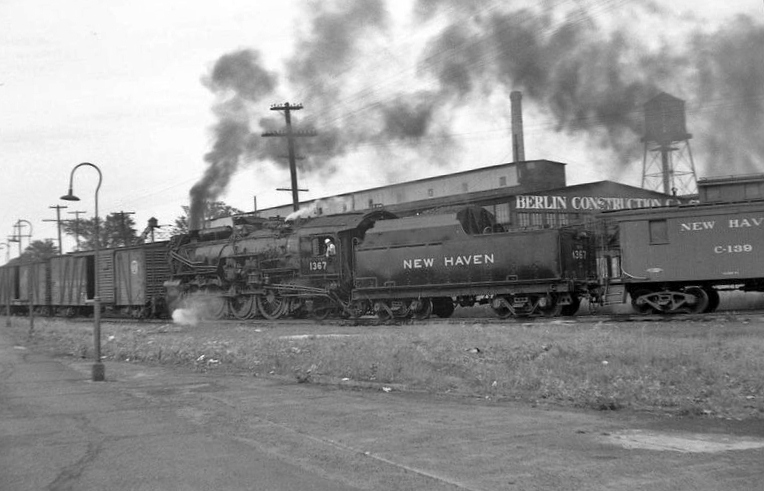
What about pre-1950? Without assignments, my next primary source is photos. Unfortunately, pictures of the cabooses on these trains are rare, although we have NE class C-139 pictured in 1945. It was condemned in 1951. Another picture of 0606 in Plainville clearly shows it's using an NE-5 class caboose in July of 1947, but I can't make out the road number. NE-5 class C-528 was assigned to NY-4/YN-3 when it was reinstated in spring 1953, so I'll go with that for now.

So I'll add C-139 as an option for 1946-1948, and also use C-528. I also know that NE-5 C-546 was assigned to HDX-5 (the New Hartford local) in 1950 and '51. But all of the photos of HDX-5 running behind K-1-d 479 show NE class C-116. So during those years I can also use C-546 for NY-4/YN-3 through 1948.

NE Class
C-139

NE-5 Class
C-528
C-546

NE-6 Class
C-701
C-708
C-709

Models
The NE class is the Crown Custom brass model, which are just about perfect out of the box. I swapped out the brass trucks for Kadee, and then I'll have to take a closer look at what else to do. 

The NE-5 cabooses are two different models. One is an Overland brass one, but I replaced the floor with the Intermountain floor, and also installed the Intermountain interior. I still need to add the missing ribs to the roof.

The second one is a modified Intermountain one. I corrected the end windows and added the missing ribs on the end, added the towing staples. and replaced the running board with the correct one. I just need to get some decals printed, since none of the sets that have been released are correct. I'll need those for the NE-6's too. If modifying the ends wasn't so much work, they would be the obvious choice. The body is already drilled for the towing staples, and it's easy enough to swap out the running board.

The NE-6 cabooses are the Atlas model, with new running boards, and using the Intermountain underframe and interior again. The Atlas underframe is sparse, and the caboose sits too high. Otherwise it is more accurate than any of the brass ones. I'm using the accurate Tahoe trucks on all of the steel cabooses.

Operations
For operating sessions, crews start the day with a cut of cars left by NY-2.

NY-4 is the only train staged coming from Cedar Hill up the Berlin Line and terminates in an empty track in the main staging yard. Neither the locomotive or caboose will return that session.

YN-3 is already staged to come out of Holyoke/Plainville with separate power and caboose, and terminates in the track vacated by NY-4.

As noted, the crews also block cars for YN-1 to pick up after the session ends. 

Time to get working on those RS-2s and NE-6s...

Thursday, July 2, 2020

Operations - NY/YN (Cedar Hill-Holyoke) Freights

The train orders in the last post were all for the The Cedar Hill (N) - Holyoke (Y) Freights, which ran twice a day through most of the era I'm modeling, All of these trains dropped and picked up cars in New Britain, Plainville, Westfield and Holyoke. 

NY-2 was in New Britain around 4.30 AM, and Holyoke about 7.45 AM, so perhaps some will turn up there. It handled perishables for Meriden and New Britain, along with New Britain Merchandise (L.C.L) traffic. It won't be seen on the layout, but leaves a cut of cars at Whiting Street Yard that is waiting for the switching crews when they come on duty.

NY-4 was in New Britain around 8.20 or 9.20 AM.

YN-3 was in New Britain around 2.50 to 3.30 PM, depending on the year. As such, it's the most photographed of these trains.

YN-1 typically left Holyoke around 6.20 PM and was in New Britain around 8.40 - 9.00 PM. This is after the end of the session, but the crews will block at cut of cars to be picked up overnight.

Although listed a symbol freight, NY-4/YN-3 operated like a local freight, servicing Cremo Brewery, which is in New Britain, but on the Springfield Line, along with Berlin and Avon to Southwick, which are all towns north of Farmington on the Canal Line. In years where HDX-5 (the New Hartford local, later NX-25) wasn't running, then these trains also served Farmington, Unionville, Collinsville and New Hartford.

Steam
I have quite a few photos of  YN-3 under steam, starting with  I-4 1367 and NE class caboose C-139 at Berlin station on September 8, 1945. It may have been stopped to get orders, or it might have been heading to Cremo Brewery which was just north on the Springfield line.


Here it is switching cars on the wye:


And heading back to Cedar Hill in Kensington, just south of the last photo after reassembling the train.

Photographer unknown, but probably Kent Cochrane.

An I-4 would have been an unusual locomotive on this train at the time. As the orders show, it was usually a J-1 such as 3008, seen here in Plainville on YN-3 (date and photographer unknown):


However, I now believe this is a photo of HDX-4, the Waterbury to Plainville local which was noted on April 20, 1948 as using J-1 3010, seen here at the eastern portal of the Terryville tunnel:


And at the western portal:

Date and photographer unknown, but c1944-5, probably Kent Cochrane.

On Sundays NY-2/4 and YN-3/4 were combined into a single train, which sometimes required double-heading to get up the grade in Berlin, such as on this June 1940 day:


Diesels
These were the first freights running through New Britain that was dieselized, although they would probably be more properly called Canal Line jobs rather than Highland Line, as that's where they did most of their work. These trains came up the Springfield Line, heading toward Plainville through New Britain via the wye in Berlin. due to the Canal Line south of Plainville being single tracked, lighter rail, and with clearance issues in North Haven.

Locomotives 0605 and 0606 were normally assigned the NY/YN freights from 1945 until they were replaced by DERS-2b (Also RS-2) locomotives, numbers 0502 and 0503. In both cases these were specific assignments since they were the only locomotives of their class at the time with Springfield Line ATS installed, which was required for the portion of the run from Berlin to Cedar Hill.

Here 0606 is on YN-3 in Plainville on July 7, 1947. Note the NE-5 class caboose (I can't read the number, unfortunately):

This looks like the same day:

Here YN-3 is at Cook's Quarry in Plainville, just about to enter New Britain, date unknown:


About a mile down the tracks is Wooster St in New Britain where Kent caught NY-4 on Christmas Day 1947:

Although the information I have so far indicates 0605 and 0606 were assigned to the Holyoke freights, both the train order and a couple of photos indicate that 0604 was sometimes used as well. This photo was taken at New Britain Station/Yard.

0604 had dual (Shoreline and Springfield line) Cab Signals, and at the time may have been the only other DEY-5 (Alco S-2) equipped for Springfield Line service, although 0616 had dual cab signals by 1950.


On this snowy day in January, 1947 we see 0604 with YN-3 on the wye in Plainville (you can see the train curving to the right). On the eastbound main is I-1 1001(?) with train #157 on its way to New Britain. On the westbound main in the distance you can see the caboose of HDX-4 on its way back to Waterbury. 

Unless otherwise noted, these are all YN-3, heading back to Cedar Hill, c1946-7, by Kent Cochrane.

On the Layout
NY-4 drops off a cut of cars at Whiting Street yard about 30-45 minute into the session using the 4:1 fast clock. YN-3 will come back to pick up cars about 2 hours and 15 minutes later. 

NY-4/YN-3 runs daily until it was dropped in 1952. It looks like 0606 would run through at least the end of 1947, but from 1948-1951 it will be DERS-2b (Alco RS-2) 0502. The RS-2s seem to be among the most elusive locomotives on the NH, with few photographs in service. I have none on the YN-3 trains, despite the dozen or so prior to their assignment I've shared here. 

NY-2/YN-1 continued until the end of the New Haven of course, as the train orders show. Starting in 1952 the RS-2s were replaced with DERS-2c (RS-3) locomotives. So through the 9 years I'm modeling, they went from steam and through 3 progressively heavier classes of diesels as they were delivered.

The RS-3s replaced by a pair of DER-2a (FA-1) locomotives in 1956, which is the first move to an older class of locomotives in this era. They were still servicing the trains in 1957, the latest Engine Assignments I have.

As noted in the last post, the train orders from '68 have a DERS-5 (DL-701) or DERS-4 (GP-9).  

In my case, I'm working on 0502 for 1948-1951 ops sessions, and I'll also need to get 0606 for 1946-7 sessions. Work continues on the RS-2s (I'm also still doing 0503 too, since Life-Like used that as one of the two road numbers):


I need to finish the frame and some underbody details and install the decoders. Oh, and a little detail coming soon from my buddy Jim Lincoln...


I need them for the S-2s, RS-1s, RS-2s, and RS-3s.