Showing posts with label Commodities. Show all posts

Monday, June 3, 2024

Springfield Traffic


Marc at work had a small stack of a little over 100 Home Route cards that came out of Springfield.  The cards are all dated from February and March 1946, although not all originally routed through Springfield. 

Springfield

For Springfield there are 29 roads represented (71 cars, one of which I can't identify the road).  They are not necessarily roads I expected.

  • PRR - 10 - 14%
  • B&O - 8 - 11%
  • BM - 7 - 10%
  • CP - 7 - 10%
  • ATSF - 4 - 6%
  • CNJ - 3 - 4%
  • FGEX - 3 - 4%
  • CG - 2 - 3%
  • D&H - 2 - 3% 
  • GARX - 2 - 3%
  • MDT - 2 - 3%
  • MEC - 2 - 3%
  • RDG - 2 - 3%
  • SRLX - 2 - 3%

  • ARLX - 1
  • ART -  1
  • BLE - 1
  • ERIE - 1
  • IC - 1
  • L&N - 1 
  • MILW - 1
  • NADX - 1
  • NH - 1
  • NP - 1
  • PFE - 1
  • SOO - 1
  • SOU - 1
  • VGN - 1

The mix of cars is also interesting:

  • Box Cars - 25 - 35%
  • Reefers - 14 - 20%
  • Hoppers - 21- 30%
  • Gondolas - 7 - 10%

I was surprised to see two Canadian Pacific stock cars and a ventilated box car (Central of Georgia).

Ventilated box car CG 55991 arrived via Springfield on February 18, 1946.  It went to Bridgeport on February 20. It appears to have been released on February 28, and was then routed via Cedar Hill on March 1 on its way back to Springfield, also on March 1.  It's interesting that it came into the NH via Springfield, but assuming it was empty on the way out, the car routing rules indicate it should be sent out via the same route it arrived. 

The selection of cars routing via other points is too small for any meaningful analysis, but still interesting. There was one Southern box car via Harlem River and one CN box car via New London. Via Worcester there was an MEC and Wabash box car. 

Bay Ridge (15 cars)

CP, PFE and SOO with 2 cars each, plus one each of ART, BM, GARX, NP, OWR&N, SAL, SFRD, and Southern.

Seven each of box cars and reefers, and one hopper (Boston & Maine).

Oak Point (10 cars)

Half were CP, 3 box cars, a reefer and a stock car.  Two Southern box cars, and an ART and MDT reefer.

Maybrook

Thirteen cards were for cars routed via Maybrook. Eight of those were reefers: 1 ART, 1 LRX, 1 MDT, three PFE and an SFRD. I'm not sure on the last one. Two CP box cars, and one each of B&O, BAR, and IHB.

--

Although the number of cards is too small to derive any real info regarding routing, I think there are still some interesting things to note.

I was surprised as the number of Pennsy and B&O cars coming via Springfield, but I have a probably explanation. I think many of these specific cars were on their return leg. That is, a B&O or PRR box car that originally carried a load to, say, Maine was unloaded when it arrived at its destination. Car routing rules specify a car that is not reloaded be routed back the same way it arrived. If the car was originally routed to the B&M via the New Haven, it would have likely gone through Springfield. So it would come back via Springfield too. They could also be loaded and routed via the NH.

What does that mean for my modeling purposes? That cars I might not have considered routing via Springfield could be part of the consist of a Hartford to Maybrook freight. 

This is the first documentation in my era of a ventilated box car on New Haven rails. I was also surprised the two stock cars were CP, one at Springfield and one at Oak Point.

The mix of hoppers is always something I'm interested in learning more. In this case it was B&O (4), BLE (1), B&M (2), CG (1), CNJ (2), D&H (2), Erie (1), NH (1), PRR (6), RDG (1), and VGN (1). The anthracite roads all make sense, although all of them were via Springfield. The D&H cars were probably loaded, but I suspect the others were all empties on their way home.

The B&M ones (one at Springfield and one at Bay Ridge) are more interesting. Without knowing the commodity, I'm guessing these cars may have been related moves since they had so few hoppers.

The CG and VGN were also unusual. If they were bituminous coal, they were a long way from home, especially when the bulk of coal from their region would have come by water via Baltimore.  Again, these went via Springfield, so it's likely that the NH was simply part of the routing.

I also didn't expect reefers to be the second most common cars. The mix was not quite what I expected (although being February would have an impact on what commodities were shipping and from where). PFE was the most numerous at six, but ART and MDT were second with four each. CP, FGEX, and GARX all had three, and SFRD and SRLX had two each. The LRX car is an interesting one too, not many of those.

There are no tank cars at all, but this is expected because they always ran on a waybill. They would not use Home Route Cards.


Wednesday, March 15, 2023

Livestock and Stock Cars

I started this post some time ago and never got around to finishing it. Something to do on a rainy/snowy March morning...

NH DERS-2c (RS-3) 517 on the Air Line at Middletown with a stock car.

Were stock cars common on the New Haven?

Looking through photos, these are the stock cars I've been able to personally verify on the New Haven. I've included the number of stock cars owned by that road, and rankings in parentheses for those roads that were in the top 15 owners of stock cars in 1950. 

  • CB&Q - 3,573 (3rd)
  • DL&W - 97
  • ERIE - 82
  • MILW - 3,690 (4th)
  • NYC - 1,675 (12th)
  • PRR - 2,315 (9th)
  • SLSX - 713 (Swift)
  • WAB - 594

The Swift cars (and Armour, below) would have been destined for their own plants, as photos of the Swift plant in New Haven have shown.

Other cars I would expect may have made it to the New Haven regularly:

  • ASEX - 200 (Armour)
  • B&O - 1,192 (14th) 
  • CGW - 150
  • CNW/CMO - 3,736 (6th)
  • IC - 1,100 (15th)
  • Mather - 1,444 (B&O, CNW, and CB&Q leased from Mather, may not be included in their totals)
  • RI - 1,207 (13th)

Of course, cars from other roads would be possible. The Santa Fe accounted for 13% of the North American stock car fleet in 1950, and of the 66 roads that owned them, only 18 roads accounted for more than 80% of that total.

But just because these cars were photographed on the NH doesn't mean they were common. How frequently did stock cars actually move on the New Haven? More often than you might think.

I touched on it briefly in an earlier post on commodities because I was surprised to find that swine (in double-deck cars) was the 17th largest group into Connecticut based on number of average annual carloads. This is calculated using the 1% waybill studies from 1950-54, and I was only looking at the statistics for Connecticut (which would also include traffic on the CV delivered to Connecticut).

Fresh Meats NOS (not otherwise specified) was the 6th largest group, averaging about 7,392 carloads annually. But Swine DD (double-deck) was 2,300, plus another 300 single-deck cars, and 250 single-deck cars of cattle/calves. No cars of sheep/goats were recorded. That's an average of almost 8 stock cars/day delivered to Connecticut.

Livestock Traffic

Where does the livestock originate? The cattle to Connecticut tends to come from a bit farther west than the hogs. Major stockyards in those states are listed below. The roads noted correspond to the cars noted above:

  • Illinois (Cattle - 100; hogs - 475)
    • Chicago - All except DL&W
    • East St. Louis - B&O, CB&Q, IC, NYC, PA, RI, SLSX, WAB
  • Indiana (Hogs - 775)
    • Indianapolis - B&O, NYC, PA
  • Iowa (Cattle - 50; hogs - 1,050)
    • Dubuque - CGW, IC, MILW
    • Sioux City - CNW, IC, MILW
  • Minnesota (Cattle - 25)
    • Austin - CGW, MILW
    • South St. Paul - CGW
  • Nebraska (Cattle - 25)
    • Omaha - CB&Q, CNW, MILW, WAB
  • New York (Cattle - 50; hogs 75)
    • Buffalo - B&O, DL&W, ERIE, NYC, PA
  • Ohio (Hogs - 225)
    • Cincinnati - B&O, ERIE, NYC, PA

Armour and Swift operated out of all of the major stockyards.

As for destinations? Middletown had a slaughterhouse, which is where the stock car in the photo is headed. Copaco in Bloomfield was another destination, as was Swift and Sperry & Barnes in New Haven. There were other industries and stock pens at Hartford, Providence, Boston, and other locations on the NH.

I have seen it mentioned several times that some of the movements were to the locations with large Jewish populations for kosher meat. That may account for the cattle, but certainly not the hogs. At least in the Bloomfield, Hartford, and New Haven areas there were a significant number of sausage companies. 

Models

The majority of these roads can be modeled, including all but two roads that I have documented on the New Haven.

Plastic models have focused on the western roads - ATSF, SP and UP. This makes sense because they owned more than 27% of stock cars in 1950.

The Proto 2000 Mather stock car plays a big part in modeling stock cars east of Chicago/St. Louis. Otherwise, for accurate stock car models, you'll have to look to resin kits.

  • ASEX - none
  • DL&W - none
  • ERIE - none
  • IC - none
  • Mather - Proto 2000; Sunshine. Owned 1,444 cars, many leased to the following roads:
    • B&O - all Mather cars in 1950 (495 single-deck; 438 double-deck)
    • CB&Q (1948 - 60 double-deck)
    • CNW (1948 - 300 single-deck)
    • GSX (Mather reporting marks)(1948 - 4 single-deck; 19 double-deck)
    • MSCX. (Mather reporting marks)(1948 - 46 single-deck; 16 double-deck)
  • MILW - Sunshine; Westerfield
  • NYC - Westerfield
  • PRR - Broadway Limited; F&C
  • RI - Westerfield (kitbash)
  • SLSX - none
  • WAB - Yarmouth

Trains

The blocking information in the Arranged Freight Symbol Books includes some regular livestock movements. For example, SN-3 has a block of New Haven perishable & livestock. But it does not have a block that specified Hartford livestock. Nor does any other train, but cars for Copaco in Bloomfield would have been delivered by the Griffins local, originating out of Hartford.

Also, while many photos on the New Haven have stock cars behind the locomotives, the New Haven livestock block is the second block in the train. 

I think it's most likely that stock cars for trains originating in Hartford would have come via Springfield. But it's possible that they could come via Maybrook, and run through New Britain. So the few stock cars I might run would be on a Maybrook freight. Obviously the Mather and Broadway PRR K-7 are the easiest ones to model. But I'll probably build Westerfield MILW and NYC cars eventually, since I think those were among the most common.

There are no industries receiving stock cars (of which I'm aware) west of New Britain on the Highland or Canal Lines. So that's the only train that would potentially have any stock cars on my layout. When the Maybrook-Hartford freights aren't running at all, I won't need any at all.


NH DERS-2c (RS-3) with a Milwaukee stock car.

Wednesday, March 16, 2022

Poultry Cars on the New Haven?

Rick Abramson (see his layout tour here and part 2 here) asked a question on the NHRHTA Forum about whether live poultry cars operated on the New Haven. My initial response was going to be, "If we know that the New Haven shipped this (at least once), certainly poultry cars ran on the line."

But then I started to dig to confirm what I knew (and didn't) and as usual, the post grew...

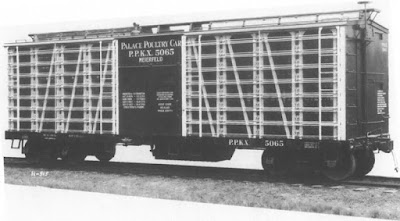
PPKX 5065 (Parlor Palace Car Co)

The 1% waybill analysis of 1949 listed only 1 car (7 tons) from Indiana to New York. In 1948 it captured 1 from Indiana to Delaware, 2 from Indiana to New York, and 1 from Iowa to Pennsylvania.

The problem is, with so few of these cars, the 1% data may be incomplete and inaccurate. This would imply that there were only 100 carloads in 1949, all destined to New York, and 400 in 1948. Could this be correct?

Unfortunately, I haven't been able to find complete waybill analyses prior to 1948. Time to find some other sources.

The primary resource regarding live poultry by rail is an article by John H. White, Jr, (the senior historian for transportation at the Smithsonian Institution) published in Agricultural History 63.3 called Home to Roost: The Story of Live Poultry Transit by Rail.

Kristin Dummler also posted an excellent clinic on the history and modeling of poultry cars. Kaylee Zheng has also presented clinics on these cars.

These resources cover the history of the cars and their use, so I'll focus on the question: did poultry cars run on the New Haven?

Baby Chicks

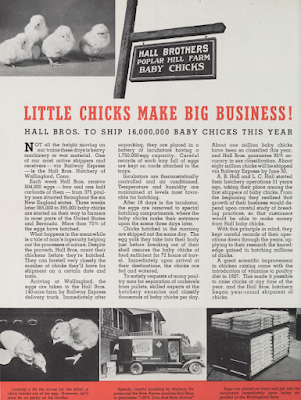
I'm not sure baby chicks are included in the Live Poultry classification. Because they didn't need to be fed for 72 hours, they were shipped in boxes the same day they hatched, via Railway Express Agency. And many of them from the New Haven.

Here's an Along the Line article from June 1942 where it notes that Hall Brothers Baby Chicks in Wallingford shipped 16,000,000 chicks that year:


But that doesn't address the question of live poultry cars.

Live Poultry Traffic by Rail

Live chickens, turkeys, pigeons, and probably other poultry used to be shipped by rail. As noted by John H. White, Jr., the late '20s saw an average of 12,000 carloads nationwide annually, with 2,800 live poultry cars in service headed for most major cities in the country. In 1928 51% of live poultry was shipped by rail. By 1940ish it was down to 27%, lost primarily to competition by trucking. The WWII spike was 3,376 carloads in 1944.

In terms of the poultry cars themselves, by 1947 there were only 237 cars, and only 15 in 1950. The low quantities listed in 1948-9 are reasonable, although probably a bit below the actual totals due to the low number of cars and shipments. 

John's article notes that a survey history of the industry published in 1973 indicates Live Poultry car service ended in 1956, but the railroads continued to report live poultry shipments until 1961. I can't find any Live Poultry cars listed in the 1953 or 1954 ORERs. Regardless, with only 15 cars remaining, the live poultry by rail business was all but over by 1950.

Of the live poultry traffic, he reports up to 60%+ was destined to New York City. Fleshing this out are some statistics I pulled from 1921 Legislative Documents for the NY, NJ Port and Harbor Authority mentions that the majority comes via the Lackawanna due to a special poultry facility at Hoboken that transfers the poultry to trucks bound for the West Washington Market, and over 175 local chicken slaughterhouses throughout the city.

A 1936 edition of Decisions of the ICC in 1933 notes 73.5% of all live poultry movements via rail were to New York City, this was 67.4% in 1934. Of those, 66% of shipments originated in Illinois or further west. Live poultry sourced from farms closer than Illinois came primarily via truck.

An AAR Report on Poultry and Dairy Products from 1947 indicates that 79% of the national live poultry traffic was destined for New York City in 1940, but this was down to only 38% in 1944, with terminations in Illinois rising from 4% to 21% during the same period. In this report it also notes that the number of terminations is too low to get reliable statistics for individual destinations. This is because the source of the carload data would be the annual 1% Carload Waybill Analysis, but it highlights how this data was used in numerous reports and studies produced by the AAR, government agencies, and industry groups.

John also mentions that "much of the live poultry shipped to New York, Boston, Philadelphia and Washington originates in the Del-Mar-Va peninsula." This statement (because of that "Del-Mar-Va peninsula" wording) appears to be taken from the 1947 AAR Report. Of course, traffic destined for Boston from Delaware, Maryland, or Virginia would very likely have been routed over the New Haven.

He notes that New York City was the largest market because as much as 80% of the live poultry in NY was destined for orthodox Jewish households, which is confirmed in several of these other sources. The 1918 issue of Traffic World reports that Italians in New York City also preferred live poultry to dressed. It also mentions that poultry cars would often be loaded as L.C.L and make multiple stops along the way to pick up more birds. Interestingly, the national fleet at the time was 891 private cars and 114 owned by railroads. It doesn't specify which roads owned live poultry cars, though.

The New Haven railroad also served large Jewish communities in (West) Hartford, Norwalk, Bridgeport, and New Haven in Connecticut, Worcester and Boston in Massachusetts, and Providence in Rhode Island, among others. They would require the same live poultry deliveries as New York City, although local New England farms could have addressed much of that demand, but perhaps not all. As roads and trucking improved in New Haven territory, these could be served from local as well as centralized sources.

The reports have specifically mentioned Boston, and even some of the tables have included data for that city, although not data that I could use to derive carloads for live poultry. It would be nice to find some confirmation for other cities on the New Haven.

New Haven Documentation

Is there anything we can find in New Haven published documents? Poultry cars would have been a very small percentage of New Haven traffic, but they are mentioned in various freight documents.


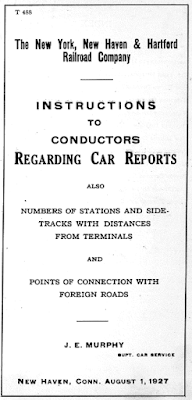
For example, the 1927 Instructions Regarding Car Reports (replaced in 1944 by a simpler document that just lists station numbers) identifies abbreviations for each type of car to be used on car reports. Live Poultry is listed here (LP) as is Palace Horse (RK). Both rare moves but still noted in the rules.

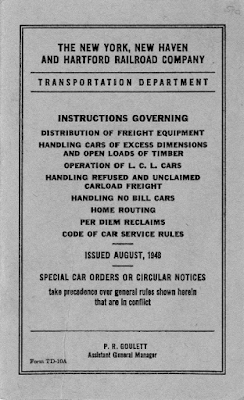
This 1948 booklet covering a lot of rules for freight also has information regarding live poultry cars.


In this case Rule 11 notes they (along with tank cars) must be re-weighed and re-stenciled only by owners and are excluded from some of the other rules on light-weighing and stenciling because of this.

In most freight rules they would fall under the "live stock" category and aren't called out individually, neither are beef and swine. But rules such as these examples show that at the very least, live poultry cars were expected to be on New Haven rails periodically.

Live poultry is mentioned in a November 1928 article about the new Harlem River express facility in Along the Line. No details, just that it is received. I'm sure there are probably other mentions through the years. As an express facility they could be referring to baby chicks.

Other Documentation Mentioning the New Haven Railroad

In a 1911 Report of the Railroad Board the New Haven Railroad reports transportation of live poultry in the amount of 530 car miles for cars owned by Live Poultry Transportation Co and 136 car miles for cars owned by Lemac Car Co. These are definitely live poultry cars, and not baby chicks via REA.

This is confirmation that such cars did run on New Haven rails. Unfortunately, that's all it provides, the car miles traveled. No destinations.

--

A December 1946 report/proposal to build a new wholesale market for fruits, vegetables, poultry and eggs and New Haven has some specific information:

"These firms receive the bulk of their poultry and eggs from midwestern sources by rail and truck. Most of the carlot rail receipts in New Haven are received at the firms' rail spur tracks. The volume by rail has shown a steady tendency to decrease during the last 10 years. This decrease has been counteracted by heavier truck receipts. Since 1940 a few of the national packers have built broiler processing plants in New England and the Del-Mar-Va area. Those plants deliver both boxed and ice-packed poultry to their local branches to meet their requirements for fresh-killed poultry."

"...New Haven is the leading poultry and egg market in Connecticut...approximately 120 cars of eggs, 110 cars of poultry, and 60 cars of turkeys of shipped-in supplies were handled by all wholesalers in the New Haven area in 1945."

"Rail receipts were from western production areas and were received principally by local branch houses of national and independent packers. Most of these firms have rail spur tracks from which they can unload their rail arrivals directly into their stores." 

Reading through the report, it's not always clearly differentiating between rail and truck traffic when referencing "carlots." So we can't determine the volume of traffic by rail. But it does specifically state that live poultry is received by both rail and truck in New Haven, and it mentions they are delivered on their own spurs. So again, live poultry cars and not baby chicks via REA.

That covers a period from 1911 to 1946 with specific information regarding rail transportation of live poultry on the New Haven which, other than baby chicks, moved via live poultry cars. The answer is yes, live poultry cars did run on the New Haven Railroad. This is also right at the tail end of live poultry car service.

Dairy and Poultry Statistics 1955 shows all live poultry into Boston came via truck from Maine, Massachusetts, and New Hampshire. Rail service is still indicated for Chicago.

Modeling

From a New Haven Railroad modeling standpoint, most won't need any of these cars. But we can certainly say that occasional live poultry cars to New Haven and Boston are a regular, although maybe not even weekly, occurrence.

Frequency would be higher through at least 1930 and might have picked up again for WWII. But I doubt there were any new destinations, just more traffic. We have confirmation that they continued through the late '40s to New Haven at least, and probably Boston. So those modeling New Haven or the Shoreline, or the electric territory, prior to 1947 can reasonably justify a car or two.

Would they be seen on anything other than Shoreline trains? Perhaps depression-era and earlier cars to Hartford and maybe smaller cities like Waterbury or even Danbury, especially pre-1928. After 1928 trucking would take a larger percentage so I think that by 1940 New Haven and Boston may have been the sole destinations remaining for rail service. Even with the 1946 report, traffic dropped precipitously enough that there were only 15 cars still in service, so I think it's safe to say that they weren't running on New Haven rails by 1950, and maybe gone as early as 1947. 

Wednesday, September 1, 2021

Middle Atlantic Transportation Co (and a bonus)

I was poking around looking for a colorized picture I had seen a while ago for a truck from Middle Atlantic Transportation Co. Because of the name of the company, I've always had trouble finding them, and I thought I had downloaded it, but couldn't find it.

Imagine my surprise when I stumbled across this at Getty Images.

The company was headquartered in New Britain, near Wooster St, and photographed by William C Shrout in a series of pictures taken in 1942 for Life magazine. I don't believe they were ever published. Not all of the photos were taken in New Britain.


Middle Atlantic Trucking terminal, New Britain, CT.

I don't think they were served by the railroad, as they were a competitor, shipping freight between New Britain (Hartford), New York, Cleveland, and Detroit. But I'm working on getting decals produced so I can have a truck on the layout somewhere since it's a local company. The video is the first color image or video I have found from the era. Based on the video I'll be using a 32' Fruehauf Aerovan trailer from Wiseman Model Services, and a Sylvan 1948-53 C6100 2-ton tractor. These look like exact matches.

Unfortunately the terminal is located off the layout, otherwise I would do several different trucks.


Landers, Frary & Clark

In the process of searching for that, I found another set of unrelated (but interesting) videos.

This is a series of newsreels that was also apparently never released. It shows how the Landers, Frary & Clark Coffeematic Pot is produced. While interesting in and of itself, what's most useful to me is to learn that the pot was made of copper, and also copper-, nickel-, and chrome-plated. These, of course, are commodities that I'll need to have shipped to the plant.

Friday, June 4, 2021

Commodities - Road Salt and Chlorine

One of the "industries" to receive cars in New Britain is the Town of New Britain itself. The track is often labeled as New Britain Water Works on older maps.

I don't have any pictures that give me any information in regards to what might have been received here. Aerial photos from 1934 and 1951 are inconclusive, although it doesn't appear there is anything in regards to structures or tanks.


Broadway Limited chlorine tank car models on the Town of New Britain track.

My thoughts were that it functioned much like a bulk/team track, where the town would receive shipment of bulk goods, such as chlorine for treating the water and road salt for the winters.

Road Salt

In Jeff's Wilson's Industries Along the Tracks 4, there's a chapter on salt. I had already learned that NY state was a significant supplier of salt during the era. I figured that road salt would be a good choice for servicing the town side track. But Jeff indicates that the widespread use of road salt didn't begin until after WWII.

I found this report that confirms this. So salt isn't likely, but what I didn't know is that sand and cinders were used to provide traction, prior to the widespread adoption of salt. 

Chlorine

I was also able to find some information regarding the use of chlorine in city water. This was widely used by my era, and the volume of chlorine that would be needed for a small city of 75,000 people would certainly make delivery by rail a possibility if not likely. I haven't been able to find definitive information that the chlorine used in city water treatment would have shipped in tank cars, but that's my current guess.

What's not clear is how the town would have received the chlorine if it's coming in tank cars. Since this track is often labeled as New Britain Water Works, I'll go with the idea that there is some sort of unloading pipe. It's also possible that if they did receive chlorine by tank car that they unloaded them directly into trucks.

--

While it would be nice to find some definitive information as to what was received on this track, in this era sand, cinders, chlorine, and also shipments of asphalt, crushed stone, gravel or cement would all be reasonable bulk shipments to a large town or small city. In Jeff's book there's a picture of a gondola being unloaded by hand into dump trucks at a bulk/team track. That's a lot of shoveling.

Many towns might just receive such goods at the bulk/team tracks. But for a small city like New Britain, shipments must have been fairly regular and having their own track makes sense.

Monday, May 31, 2021

Traffic Flow - New Britain Gas Light Co


One of the major industries I'm looking forward to building is the New Britain Gas Light Co. I experimented with modifying the Walthers kit a while ago. I've since picked up several more, since I'd like to see if I can fit in two tanks, which will also serve as view blocks. I've also been picking up supplies to scratch build the supporting structures. I'd prefer that it look different from the stock Walthers kit (it will be right by the aisle), and the structures for the two tanks were quite different from each other and I'd like to capture that.

But I've continued to try to dig up more information about the industry itself, and decided to pick up Jeff Wilson's Industries Along the Tracks 4.

Although the whole book is interesting and well written, the information on the Coal Gas industry was the most in-depth.

There were actually two similar products produced and stored in tanks like these for gas lighting, heating and cooking. These were predecessors to, and entirely replaced by, natural gas. Underground pipes were run to homes and businesses to deliver the gas, which also made it easy to convert a city to the less expensive natural gas in the '60s.

I was familiar with Coal Gas, which is a flammable gas captured from burning coal. The biggest by-product of this is coke, and I didn't know what New Britain Gas Light Co did with this. Did they sell it locally and truck it to dealers? Did it get shipped out in hoppers to be used elsewhere? I wasn't sure, and hadn't found any info.

The second process is known as Water Gas, which is also known as the Lowe method. In this process, steam is injected through the burning coal. The resulting gas is less volatile than traditional coal gas, but it is then processed in a carberettor where vaporized oil is infused into the gas. This was actually the more common method of manufacturing gas. Most importantly for my research is that the fuel used to produce the gas could also be coke instead of coal.

In the book Jeff mentions Brown's Directory of American Gas Companies. As always, Hathitrust has several editions. The entries are financial in nature. I found that the 1917 edition had some key information not in the 1918 edition:


It notes that New Britain Gas Light Co uses the Coal and Lowe processes. Even better, it notes the annual production of 100,000,000 cu ft of Coal Gas and 161,000,000 cu ft of Water Gas. The population served in 1917 was ~43,000 (and even notes the number of ranges, water heaters, and arc lamps). 

Jeff gives some rough estimates of how much coal and oil is required for a given amount of gas. Based on those, I've come up with about 400 hoppers and 40 tank cars of crude oil needed annually, or 1-2 hoppers and 0-1 tank cars daily. 

Sure enough, the Sanborn Maps show all of the relevant structures which correspond with the descriptions in Jeff's book.


1950 Sanborn Map
Note the corrections with physical paper glued over the original.


1954 Sanborn Map
The Oil House has been replaced by horizontal tanks.

I'll need a vertical oil storage tank as well. There is quite a large amount of oil storage capacity on the property, so I may lean towards 1-2 tank cars/day.


1909 Sanborn Map

This is the closest I have to the 1917 date. Looking at the 1909 book, the population is lower, but the total capacity of the tanks is the same, at 950,0000 cu ft. By 1950 a 2,000,000 cu ft tank has been added, so the capacity is 3x the 1909 numbers. So perhaps 2-4 50-ton hoppers and 1-2 8,000 gallon tank cars daily would be a better average.

If I really feel that it's necessary, 1950s era copies of Brown's exist, but just aren't accessible to view digitally. But I'm comfortable with this rough measure for now.

Friday, February 5, 2021

More Routing

Other than the historical interest, how can the routing information be used on a model railroad?

If you are using more prototypical waybills, then the routing information is included on those. But I also think it's useful for building trains that will be running on the layout, as I've noted before.

This is a Freight Interchange Report for the New Haven, 1929. I don't recall where I got this, but it's interesting in that it shows how many cars were received at each interchange over the course of a year.


The map includes the traffic from 1918 through 1929, here's the list for 1929, arranged by road and interchange since it's the closest to my era.

B&A Framingham    47,742
B&A Milford    1,270
B&A Pittsfield    13,497
B&A State Line    39,029
B&A Westfield    11,536

B&A, B&M Boston    109,447
B&A, B&M Springfield    156,235
B&A/B&M Worcester    260,873

B&M Ashland    123
B&M Clinton    931
B&M Concord    2,768
B&M Easthampton    750
B&M Fitchburg    19.082
B&M Holyoke    5,078
B&M Lowell    56,357
B&M Northampton    3,651
B&M So. Sudsbury    1,738
B&M Turners Falls    1,866

CV New London    57,878
CV Norwich    792
CV Willimantic    58,670

LIRR Fresh Pond    29,650

LV, CNJ Harlem River    265,104

Maybrook     553,029 (ERIE, L&H, LNE, O&W, NYC)

NYC Beacon    9,148
NYC Boston Corners    224
NYC Brewster    790
NYC Millerton    359
NYC Port Morris    12,023
NYC Poughkeepsie    5,653
NYC Rhinecliff    677

PRR Bay Ridge    430,803

The top 5 Interchange Points account for 77% of the traffic on the NH:
Maybrook - 26%
Bay Ridge - 20%
Harlem River - 12%
Worcester - 12%
Springfield - 7%

Add in two other roads that aren't represented yet, the CV at Willimantic and New London (3% each); and the LIRR at Fresh Pond (1%) and you have 84% of the traffic, covering all of the Class I roads that interchange directly with the NH.

What about the other 16%? We know that many interchanges were used for local traffic only. For example the B&M at Northampton, or B&A at Westfield, generally handled traffic for the Canal Line north of Plainville. This is true of almost all of the other interchanges. 

Looking at New Britain

As we've learned, the Interchange Points that handle traffic bound for New Britain are all of the top 5, plus Willimantic and New London. Obviously not all traffic that came through these points are bound for New Britain. But the percentages can help set a baseline for determining how much traffic is on each train. 

If we only consider interchange points that have published routes to New Britain, the percentages are:
  • Maybrook - 31%
  • Bay Ridge - 24%
  • Harlem River - 15%
  • Worcester - 14%
  • Springfield - 9%
  • Willimantic - 3%
  • New London - 3%
  • Fresh Pond - 1%
We could adjust the numbers for Bay Ridge and Harlem River by attempting to remove coal. It's my understanding that only coal for destinations along the west end of the Shoreline and NYC came by car float, and the rest was routed via Maybrook. Based on the 1950-54 numbers, coal accounted for about 15% of all traffic. Remove 15% of the cars from Bay Ridge and Harlem River and the numbers change slightly.
  • Maybrook - 33%
  • Bay Ridge - 21%
  • Harlem River - 13%
  • Worcester - 15%
  • Springfield - 10%
  • Willimantic - 3%
  • New London - 3%
  • Fresh Pond - 2%
We also have to consider routing within the New Haven, because many of these are consolidated at Cedar Hill or Hartford.
  • Cedar Hill (Bay Ridge, Fresh Pond, Harlem River, New London, Worcester) - 54%
  • Hartford (Springfield, Willimantic) - 13%
  • Maybrook - 33%
Note that Maybrook traffic was run via Cedar Hill in 1949, 1950 and 1954 in my era, so that mix is:
  • Cedar Hill - 87%
  • Hartford - 13%

Building Trains

So how do we assign this to trains?
To make the math simple, we'll say 100 cars will move through these interchanges.
  • 54 from Cedar Hill
  • 13 from Hartford
  • 33 from Maybrook.
In 1948 there are the following in-bound trains that will be staged:
  • OA-4 (Maybrook) - 16 cars
  • OA-6 (Maybrook) - 17
  • NY-2 (Cedar Hill) - 27
  • EA-2 (Bridgeport) - ??
  • NY-4 (Cedar Hill) - 27
  • HDX-5 (Hartford) - 13
EA-2 is an unusual case, handling traffic for Waterbury, New Britain and Hartford from Bay Ridge, Harlem River, and Maybrook via Bridgeport. It connects from primarily from GN-4, plus OE-2 and NO-21 and I believe is largely LCL traffic since it's the reverse move of ANE-1, part of the Speed Witch. So we can shift cuts to that train as well (this it the last year it ran). 

These are blocks bound for New Britain, though, which means the trains will have cars bound for other destinations too. Those are some long trains in HO scale. I think for my prior ops sessions we moved about half that. so:
  • AO-4 - 8
  • OA-6 - 9
  • NY-2 - 13
  • EA-2 - ??
  • NY-4 -14
  • HDX-5 - 7
That looks more manageable, although the NY/YN freights will still be large. But we can move a portion of that to EA-2, or three 9-car blocks.
  • NY-2 - 9
  • EA-2 - 9
  • NY-4 - 9
In my case, though, we're modeling the day job. So all of these trains, except NY-4 and HDX-5 run overnight. They are staged as cuts left for the crew to work.
  • NY-2 - 11
  • EA-2 - 11
  • NY-4 - 5
NY-4 is a maximum 14 car train due to my staging, but it was also the Canal Line (North) local, so I expect that more traffic for New Britain would be on NY-2, so we can shift 4 cars back to that.

So there would be two Maybrook cuts on Track 5 in New Britain (8 and 9 cars), plus EA-2, another 11 cars also on track 5, for a total of 28 cars.

A Cedar Hill cut of 11 cars will be waiting on Track 6 at Whiting Street Yard. 

During the session, 5 cars will be dropped at Whiting St by NY-4, and 7 cars from Hartford on HDX-5 on Track No. 5 in New Britain Yard.

In '49. '50 or '54 where there are no Maybrook freights, the traffic is quite different, since it moves an additional 28 cars to NY-2 and NY-4. Since I have limits on the length of NY-4, most of these would be left as a cut overnight from NY-2. However, the Maybrook freights were dropped because of a decrease in traffic, so it would be reasonable to reduce the overall session to, say, 30 cars.
  • NY-2 - 19
  • NY-4 - 6
  • HDX-5 - 5
In this case, the session starts with the majority of inbound cars, two-thirds of them. None of these are up at New Britain Yard until HDX-5 comes through. So the feel of ops sessions in these years will be distinctly different.

What About Another Location?

We could use this to look at another location, such as Chris' Valley Line. The Valley Local originates in Hartford, the Air Line Local in Cedar Hill, and then there are the two Shoreline Locals, one from Cedar Hill and one from New London.
  • Valley Local - Maybrook and Springfield
  • Air Line Local - Bay Ridge, Fresh Pond, Harlem River, Maybrook, Springfield, Worcester
  • Cedar Hill-New London Local - Bay Ridge, Fresh Pond, Harlem River, Maybrook, Springfield, Worcester
  • New London-Cedar Hill Local - New London (Central Vermont) and potentially Boston.
The most interesting thing here is that all of the cars that route through Cedar Hill bound for the Valley Line north of Middletown will come from the Air Line Local. In addition, since Saybrook is between New London and Cedar Hill, cars hauled by the CV would not go through Cedar Hill like they would in New Britain.

One can also see that for years where there is no Maybrook-Hartford freight (1949, 1950, 1954+) that the Valley Local would likely be shorter leaving Hartford, and receive more cars from the Air Line local.

Friday, January 29, 2021

Understanding the 1% Waybill Analyses

 I've been working through compiling more data from the 1% Waybill Analyses from my era. I find this sort of thing quite interesting. I've posted links in the right column for several of them hosted at Hathitrust. If you are using the mobile version of the site, click 'view web version' at the bottom of the page to see that column.

I think it's important to understand what this data is, and what it isn't.

First off, there are a lot of books/documents that were generated from this data. The links I provided include the state to state traffic of carloads for each commodity class. These are the classes from the AAR Freight Commodity Classification book I mentioned in a prior post.

There are territorial studies along with others, but my interest is in the origin of traffic to CT, and the destination of traffic from CT.

  • The data is for carload traffic only. It doesn't include L.C.L traffic. I do not know if this also excludes cars loaded for multiple destinations, but I suspect it does (I'll get to that in a moment).
  • It's 1% of the waybills for a given period. Class I railroads provided data for any waybill numbered "1" or ending in "01" starting in late 1946. They also weighted the numbers to account for differences in waybill practices among roads. So the data has been massaged.
  • It also indicates that they did not report data from states where there are 3 or fewer industries shipping a given commodity. These carloads are included in the totals for the major categories. I have noticed these discrepancies when comparing the totals, and have opted to ignore these extra carloads because I don't have any way of knowing in which subcategory they belong.
  • They state the margin of error varies depending on the number of loads. For example, if there are 100 carloads reported, there's an expectation of about 10% deviation, but with 400 loads the data is more accurate, with an expected deviation of 5%. 

To put it a different way, the fewer loads of a commodity, the less accurate the data is. The number of carloads reported in the CT data is frequently less than 5. Since this is 1%, it represents less than 500 carloads. However, it's quite possible that an unusual shipment was made, and that happened to be the one waybill recorded. That one load would now be considered 100 loads.

Less frequent loads may have been missed entirely as well. Despite these potential issues, the data itself is quite useful. 

To give you an idea of the sort of thing that I think you can derive from the data, here's an interesting example.

This is the entire list of car movements for 739 Luggage and handbags, NOS (not otherwise specified)


Roughly 100 carloads a year are shipped from CT to GA, NY, TN, TX, and VA, and also from VA to CA, NY, TN, and VA.

How can we make sense of this?
I checked the Industrial Directory of CT, 1947, and I didn't find any luggage manufacturers. But I did find that there is a large number of handbag manufacturers in the S. Norwalk, Norwalk, and Stamford region. There are 18 companies with 1-50 employees and 5 with 51-200 employees manufacturing handbags. I had no idea.

What about Virginia, then? Here's an interesting blurb about the Virginia Trunk & Bag Co. Apparently Petersburg, VA was a center for manufacture of trunks and valises(?). According to Dictionary.com it's a small traveling bag or suitcase. Here's info on the Seward Trunk & Bag Co. So that confirms that VA was a source for luggage of various types.

But that still only accounts for about 400 carloads in 1949, to only four states. Looking from a different perspective, where were major luggage manufacturers? Samsonite was based in Denver, and had a plant in PA. Shouldn't they be represented too?

Hmm, let's look for other clues. Looking at another commodity, 200 Hardware NOS, I thought the number of carloads (700) and number of destinations from CT, just five states (AZ, CA, IL, NY, and OH) unexpected, considering that New Britain produces as much as 20%+ of the world's hardware in this era. Shouldn't there be more cars, or at least more destinations? Not all of the hardware would ship from New Britain, of course, but that's only around 2 cars/daily and I suspect Stanley Works alone was much higher than that.

What have we learned?
  1. Samsonite, a major manufacturer of luggage, doesn't seem to originate any rail traffic from Denver or PA.
  2. For the luggage/handbag commodity it appears CT and VA dominate the market. But all I can find are a couple of dozen small handbag companies in CT, and in both cases they are averaging around 2 cars/week for the entire group of commodities, not just a single company.
  3. Hardware shipments from CT are lower than expected, and to fewer destinations than expected.
What could explain this? Is the 1% waybill analysis wrong? No, I don't think it is. Here's what I think we're seeing:
  • These commodities ship in less-than-carload more than I expected.
  • The carload shipments are going to distribution centers or major wholesalers, who then ship primarily in less-than-carload lots.
Can we confirm this suspicion?

In the Along the Line article about Landers, Frary & Clark, they highlight their postwar line of washing machines and ranges. Like hardware, the 711 Stoves and Ranges category shows relatively few shipments/destinations from CT to GA (200), IL (100), and TN (100). (Washing machines are part of a very large category). The article also mentions that they have 8 distribution centers around the country. I haven't been able to identify where those were, but based on the waybill data I'm guessing three are in GA, IL, and TN. 

A major clue comes from another source. Some time ago I acquired a book of shipping orders from Norwich, NY on the O&W. This is all of the traffic handled by the freight agent in July, 1952. This book is string-bound, with paper glued over the binding so I can't remove the pages from the book. At least I haven't yet.


Of particular interest are the orders for several companies, who ship nearly daily. For example, the Norwich Pharmacal Co. On a given day, there is a stack of shipping orders to multiple destinations. For example, the NPCo shipments for July 1 were 43 pages. But these are small shipments, several boxes of drugs for each. Clearly this isn't 43 carloads.

The orders for Craine, Inc., for hardware, however provided clarity. Because these shipping orders include the car number.

Looking at July 10, there's a complete picture of how the railroad handles shipments from an industry like Craine, Inc. 


This is an empty car request form. I have not located one for the New Haven yet. There are several in this book. We can see that two cars were ordered by Craine, Inc by phone on 7/10/52 at 9:30 A.M. and two cars, ERIE 76199 and SOU 26266, were furnished at 1:00 P.M.

Since they ordered empties, I believe they had their own industry track. Bordens also had empty car orders. 

Note what it says in the Destination field - var - as in "various." Each of these cars has 8 orders (and would have matching waybills), because each had 7-8 destinations. Even better, it shows the route:

ERIE 76199
  • Warsaw, NY (via O&W  NYC Can LV)
  • Charlton Depot, MA (NYC (B))
  • Batavia, NY (NYC)
  • Churchville, NY (NYC)
  • Gasport, NY (NYC)
  • Gasport again
  • Medina, NY (NYC)
  • Huntington, NY (LI)

I find all of these in the Official List of Prepay and Open Stations except Warsaw, which is listed on the B&O and ERIE, not LV. I'm sure all of these are freight house stops, especially Gasport since there are two different people listed in the Notify field.

Here's a map. Of course, it's following roads instead of the railroad, but it gives you an idea of how widely this car traveled.


SOU 26266
  • Waterville, ME (Sid D&H Mcv B&M Portland MEC)
  • Dover, NH (Sid D&H Mcv B&M)
  • Barre, VT (Sid D&H RPT CVT)
  • St Albans, VT (Sid D&H RPT CVT)
  • Bellows Falls, VT (Sid D&H Mcv B&M)
  • South Vernon, MA (Sid D&H Mcv B&M)
  • Owego, NY (Sid D&H Bing ERIE)
  • Lebanon, NH (Sid D&H Mcv B&M)
The full routing is noted, including junctions:
Sid = Sidney, NY
Mcv = Mechanicsville, NY
RPT = Rouses Point, NY
Bing = Binghamton, NY

This car traveled over an even wider area:


Also note that the Agent did not follow the car loading rules when furnishing the Southern car to be routed to the northeast. I also find it interesting that there isn't a linear route among these locations.

Since the 1% Waybill Analyses only cover carloads, these sort of shipments are excluded. It's very useful in identifying the movement of commodities, but it's only part of the picture. I think it's safe to say that Stanley and/or American Hardware Corp (Russwin, Corbin Screw) had distribution centers in AZ, CA, IL, NY, and OH. But I also suspect that a large number of the cars were for multiple destinations just like what we see with Craine, Norwich Pharmacal, and several smaller shippers in the O&W book.

We have to remember that these studies were published for the government, railroads, and companies who had many other resources on hand, and were also actively involved in their industry. Each would have been utilizing the data for their own business purposes, rather than trying to backwards engineer the movement of freight by rail like we are, some 70 years after the fact. So it takes a little detective work and guesses.

But the goal isn't necessarily a full understanding of these movements either. As I've noted before, most of this information is relevant for use on model waybills, and the primary purpose of those is as "scenery" to enhance the immersion in the operating experience. All of the data I've been working through, commodity information, routing guides, etc., will help build trains that look different depending on the interchange of their origin, allows the agent/conductors to know which train is appropriate for an outbound car, and enhance the illusion that we are operating a real railroad. 

Here are the shipping orders for the two cars above in the order they appear in the book. Enjoy!


Friday, January 22, 2021

Commodities - Products of Agriculture and Animals

 There are a lot of smaller commodities, along with specialized commodities that won't come to New Britain. Livestock is one I covered earlier. Let's see if there's anything left worth looking at by category:


900 Products of Agriculture

  • 001 Wheat - 133 (NY 50, PA 50, Canada 33)
  • 003 Corn - 983 (IL 275, IN 50, IA 25, KY 25, MI 25, MN 25, NY 75, OH 425, PA 25, Canada 33)
  • 007 Oats - 708 (ME 25, NY, 50Canada 633)
  • 009 Barley and Rye - 75 (MN 25, NY 25, OH 25)
  • 015 Flour, Wheat - 3,150 (IN 50, IA 150, KS, 275, MI 25, MN 625, MO 450, NE 100, NY 1350, WI 25)
  • 017 Meal, Corn - 25 (NY)
  • 019 Flour, Edible, NOS - 275 (IL 25, IN 25, MN 25, NY 150, TN 25, WI 25)
  • 021 Cereal, Food Prep - 383 (MA 100, MI 50, NY 25, OH 25, PA 25, Canada 33)
  • 023 Mill Products, NOS - 708 (IL 75, IA 50, LA 25, MA 100, MI 50, NY 25, OH 25, PA 25, Canada 333)
  • 025 Hay - 483 (MI 100, NY 250, Canada 133)
  • 027 Straw - 50 (NY)
  • 031 Tobacco Waste - 75 (PA)
  • 033 Cotton in Bales - 450 (AZ 25, AK 100, CA 25, GA 50, LA 50, MS 75, SC 25, TX 100)
  • 035 Cotton Linters - 275 (MA 50, NJ 50, NY 25, NC 100SC 25, VA 25)
  • 039 Cottonseed Cake Meal - 350 (AK 25, GA 50, IL 125, MS 25, SC 50, TN 75)
  • 045 Soybean Oil Cake - 250 (IL 75, IN 75, OH 75, PA 25)
  • 047 Vegetable Oil Cake - 100 (GA 25, IL 25, NJ 50)
  • 199 Products of Agriculture NOS - 900 (CA 25, FL 125, IL 75, IN 50, LA 400, MA 25, NY 125, OR 25, VT 50)

There are feed dealers in New Britain. C.W. Lines on Chestnut St. Here are two views. It's on the right in the first picture, this side of the railroad tracks, and on the left in the second, on the opposite side.


This also gives us a nice view of both sides of the crossing shanty here. Unfortunately, Chestnut St didn't make the layout, the Berlin Line crosses through the helix at this point.

Reynolds Hugh Grain and Feed Co is on Commercial St, right next to New Britain Yard.


They may have received bulk grain and feed, or in bags. There's a loading door facing the tracks.

Miner, Reed and Tullock is listed as a wholesale flour dealer/broker. The building still stands, and I'm in the process of determining whether I'll build it to scale, or compress it.

There have clearly been additions, but the bulk of the building is the original one. Because these products are produced by so many producers, I'll just need to find some in each region for waybills. I probably won't need to research the remaining products of Agriculture for my layout.

910 Animals and Products of Animals

  • 215 Meats, Fresh NOS - 7,392
  • 219 Packinghouse Products, Edible - 200
  • 221 Margarine, NOS - 50
  • 225 Poultry, Dressed - 75
  • 235 Wool in Grease - 325
  • 239 Hides, Skins, Pelts - 75
  • 241 Leather, NOS - 25
  • 299 Animals and Products, NOS - 125

Of course, the most common shipments here are from the meatpacking plants. In New Britain there's the Armour and Swift plants. Of course, others may be seen too, such as this Morrell reefer:


For through freights, there are Armour, Cudahy, and Swift distribution plants in Hartford. Armour, Cudahy, and Swift are also in Holyoke. I know Wilson was in New Haven and New London, possibly others. Hormel, Rath, and Tobin all had a presence in CT, although I haven't identified towns. But they might be seen on the Maybrook freights to Hartford.

Of course, as the picture above shows, other brands may be seen regardless of whether a distribution center is present. 'Generic' meat reefers, such as Mather,  or NX, would also be appropriate.

For example, in New Britain there is also AYO Packing Co, M Krawczyk and Sons, Martin Rosol's, and Vitamin Sausage Products, all companies that make sausages and other processed meats, and would likely receive them via rail. In Hartford is Grote & Weigel, Kaufman Bros, Morris Packing, Mucke, Rex Provision, Sparvery Bros, and Stanley Provision. These would also receive reefers, even if it's at a bulk track.

The other products of animals are in such small annual quantities that I won't need to concern myself with them. For example, the 25 annual carloads of leather may be to a single industry somewhere in CT.

--

Combined with what I've covered in prior posts, those are all of the commodities for those categories that show up in the 1% waybill study.

Thursday, January 14, 2021

Commodities - Covered Hoppers


A picture I've posted a number of times, taken by Jim Karl in 1949. The last car in the consist is a covered hopper. I was wondering (once again) what might be in this covered hopper, since there isn't an industry in New Britain that would be receiving bulk cement. This car is clearly being switched since it's the DEY-4 (44-tonner) doing the work, so it was for someplace in New Britain.

On Bill's model of Livingston Manor he had learned that there was a cement company that received portland cement in covered hoppers. It was nothing more than a short trestle that allowed the O&W to drop the load directly into dump trucks. So it could still be cement, and unloaded where a conveyor could load it into trucks, for example.

Portland Cement

Cement would be the most common load in covered hoppers on through trains as well. So what models are available that I could use?

Looking at the 1% waybill study, about 1/3 of the portland cement from from NY, and 2/3 from PA. There are a number of models available that would be appropriate for those regions. The obvious place to start is the Intermountain model (with the same prototype being produced by Bowser, Eastern Car Works, and Kato in the past). Of the roads offered, I'll plan on:

Note that the D&H, NH, and LNE cars were all built by Pullman Standard and have a different hatch latching mechanism than the models (it should be "type 1c"). I've got a bunch of parts to experiment with modeling this more accurately. Unfortunately, it's not the "type 3" version offered by Yarmouth Model Works (Kit YMW 103). The New Haven car is also a slightly later lettering scheme than I will need.

Other models I have that are also good:

F&C has also released resin kits of a lot of other covered hoppers, many of which would be appropriate for me:

Atlas has also announced a run of some of the Canadian "slab side" covered hoppers we did at True Line Trains. I have a couple of them naturally, but I think it's probably unlikely that such cars would be common on the NH. F&C also has models of some of these cars.

Alumina and Aluminum Silicate

While cement is the most common load in covered hoppers in my era, it's not the only one. In researching other potential loads, I found that there are several related commodities that were common ladings. Bauxite, alumina, and aluminum silicate. Other than for aluminum products themselves, since I'm not familiar with their uses, I looked them up.

Bauxite is the stone that aluminum is mined from. 

Alumina is basically powdered aluminum separated from the bauxite. Although it has many uses, one of its common uses is as an abrasive, in sandpaper as well as cutting disks, etc. So I'm wondering if it might be used at Stanley Works or the other hardware companies.

I also found that aluminum silicate is a common ingredient in porcelain insulators. I also noticed that General Electric leased a number of covered hoppers. That got me wondering whether the GE plant in Plainville would receive them. Apparently that location was originally Trumbull Electric Co, taken over by GE, and manufactured porcelain fixtures, switchboards and panels, among other things. 

So add another Intermountain option:

Of course, that means I need to determine where such commodities would be sourced.

This lead to some interesting resources, such as this 1967 US Government report on Bauxite Reserves and Potential Aluminum Resources of the World. It's primary sources in North America are Arkansas, and to a lesser degree Alabama and Georgia in the southeast, and Oregon and Portland in the northwest.

Looking through my copy of the 1948 Rand McNally Railroad Atlas and aided with Google maps, I looked for the locations noted in the report to determine what railroads served them.

Arkansas

  • Bauxite (RI) Alcoa Mining Co, and Reynolds Metal Co

The general region on the map would also include MP, RI, SLSW, and SL-SF. The Intermountain Rock Island covered hopper is stenciled, "When empty return to Bauxite Ark."

Alabama

  • Eufala (CG)

Georgia

  • Andersonville (CG)

Oregon

  • Estacada (SP, UP)
  • Mehama (SP)
  • Portland (GN, NP, PS&S, SP, UP)
  • Salem (SP)

Washington

  • Kelso (CMSP&P, GN, NP, UP)
  • Cathlament (SP&S)

Quite a few railroads over that area which would allow quite an interesting mix of cars. So let's check the 1% waybill study for cars inbound to CT to get a mix.

Aluminum Ore is listed, would that be correct?

Checking the AAR Commodity List, 311 Aluminum Ore and Concentrates includes alumina, aluminum ore, bauxites or, bauxite ore concentrates, and bauxite. Aluminum silicate isn't noted by name, but this looks like the proper category since there are no aluminum based products listed under 399 Products of Mines, N.O.S.

And where did it come from?

75 cars from Illinois and 33 cars from...Canada?

OK, digging through some more resources like this and this. Under the heading How is Aluminum Made? on the second page it notes. "There are no bauxite mines in Canada." However, processing the bauxite takes a lot of electricity, so the processing plants are often built where electricity is cheaper, such as large rivers. 

So in Canada in my era Canadian alumina and aluminum silicate is all processed by the Aluminum Company of Canada in Arvida, Shawinigan, Beauharnois, and La Tuque, Canada, via the CN or CP. The True Line (now Atlas) slab side hopper models would be appropriate. Both CN and CP had cars appropriate for my era:

  • CN 113170-113544 series (built 1951-1953)
  • CP 380001-380200 series (built 1948)
  • CP 38201-380990 series (built 1950-1956)

In East St. Louis, the Aluminum Ore Co owned the A&S Railroad. Intermountain has a covered hopper model leased to the Aluminum Ore Co. These were owned by SHPX, and in 1952 33% of the SHPX covered hoppers were leased to Aluminum Ore Co. So these would probably be the most common cars.

Many roads served East St Louis, including B&O, CB&Q, IC, L&N, NYC (Big Four), and many others. Again, Intermountain makes cars for many of the appropriate roads:

  • CB&Q - has "type 3" hatch latching mechanisms available from Yarmouth Model Works
  • IC 
  • L&N - has the "type 2" hatch latching mechanisms
  • MP - has "type 3" hatch latching mechanisms available from Yarmouth Model Works
  • RI - has "type 1b or 1c" hatch latching mechanisms
  • SSW
  • WAB

The variations of hatch latching mechanisms, along with pretty much everything else to know about the ACF-Design 1,958 Cu Ft 70-ton covered hoppers that are the basis of the Intermountain models is detailed in Railway Prototype Cyclopedia volumes 27, 28, and 30.

Note that a number of the roads have more than one group of these covered hoppers, often with different mechanisms, or closed instead of open sides. Where possible, Intermountain appears to have only used the number groups that have the "type 1" mechanisms. Only when a road doesn't have that particular mechanism does it appear they have lettered the car without regard to the mechanism.

For those interested in the Yarmouth Model Works minikit for the "type 3" mechanism, since there is'nt a list of owners noted on the site I'll provide one here. It was used on cars owned by: ATSF, C&S, CB&Q, CIL, CNW, DRG&W, DMIR, DPCX, EJ&E, GN, I-GN, LS&BC, M-I, M-K-T, MP, SL-SF, and StL&BM.

By chance I happen to already own one lettered for Aluminum Ore company, plus a CB&Q, and WAB car from Intermountain. Lucky guess!

Kaolin

Kaolin is a type of clay used in the papermaking industry for finishing glossy papers. So cars with this commodity are appropriate for Holyoke. Nine cars owned by SHPX were built in 1940 and leased to Edgar Brothers Co of Metuchen, NJ (25051-25059). These cars had "type 1" mechanisms and open sides and are a match for the Intermountain model, although they haven't released this scheme. 

Where did Kaolin come from? It's part of 323 Clay and Bentonite, which came from quite a few locations across the country to CT:

  • CA 100
  • FL 75
  • GA 175
  • MO 25
  • NJ 25
  • PA 25
  • SC 200
  • TN 25

Edgar Brothers was based in NJ, but also mined in Edgar, FL. So these would be appropriate cars. It appears Georgia is the largest producer. I've also learned that Kaolin is often shipped as a slurry in tank cars, so that's another possibility. But since the Edgar Brothers were prototype cars, I may see if I can get some decals produced for them (or maybe Intermountain will add the scheme to their line).

Industrial Sand

Edgar Brothers also sold sand. A lot of the bulk sand sent to CT would have been used by the railroad. It would also have been shipped in bags in box car. But with an average of 1,250 cars annually, there would certainly be covered hoppers in the mix by this era. Two-thirds of this was from NJ, the rest from NY, except for a small amount (25 carloads) from Illinois. All of the local roads noted before, plus the Edgar Bros SHPX cars, would cover this traffic.

Other Commodities

Food commodities are common today, but even in my era malted barley, flour, sodium bicarbonate, and granulated sugar were shipped in covered hoppers, although I can't think of any bulk customers that would result in such loads running through New Britain. 

The same applies for fertilizer, powdered gypsum (although US Gypsum did have plants on the NH), potash, limestone, zinc oxide, etc.

Carbon black was another common commodity in covered hoppers, and while there were tire plants in CT, once again I don't think the cars would be running through New Britain. Rail Shop made a Carbon Black car (and a PRR H30 kit) but they don't seem to have an active website anymore. I have some of the Carbon Black cars and may be able to justify a car on a through train.

Kimberly-Clark leased cars from SHPX and they were based in New Milford. I'm not sure what commodity they were used for, but they would be very appropriate for somebody modeling the Berkshire line, but not coming through New Britain unfortunately (cars destined for the Berkshire from Springfield are routed through Cedar Hill).

--

Overall, covered hoppers won't be a common car delivered to New Britain, but as the photo shows they are receiving some in my era. Cars on their way to Hartford, Plainville or Holyoke are certainly appropriate, though, and with a greater variety than I originally thought.