Showing posts with label CNZR. Show all posts

Friday, December 31, 2021

Happy New Year!

Well, the last part of the year has gotten ever busier, so my modeling (and blogging) has been reduced. That's OK, it would have set a high bar to do three posts a week for an entire year. 

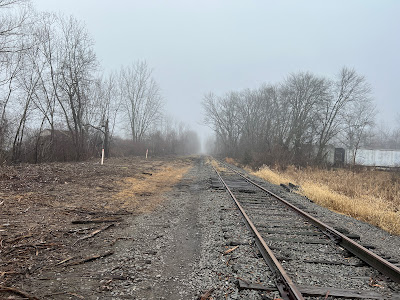
The busy schedule continues, as spent the day ballasting the Armory Line (and will probably do so tomorrow as well). It was unseasonably warm today.


You can make out the old passing siding (I think) to the left.
Probably 13' track centers. I'll have to measure it.


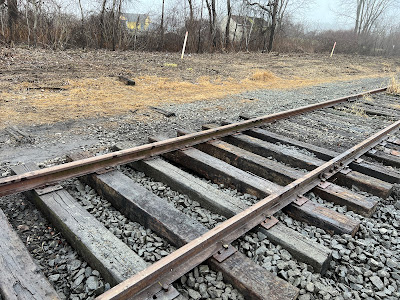
They replaced these ties, and we're filling in the ballast.

The compressor didn't feel like working today. So no tamping, just some old-fashioned manual labor with ballast forks, and then we used the Trackmobile to bring up a car full of ballast to dump along track. This section of track is still disconnected and requires work before it will support a locomotive anyway.

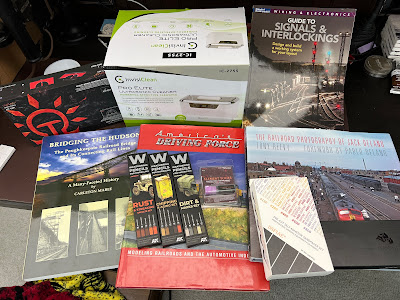
We also had a fantastic Christmas, and I got quite a bit for the railroad. A number of books, new tools and weathering pencils that I look forward to trying.


I'll report back on the tools and weathering pencils in future posts as I try them. I'll also need to look at where I stand on my current goals and how I'll address them in the new year.

Sunday, November 28, 2021

Rail Length


Getting ready to move a pile of rail from here to there at Depot St. I walked about 3 miles around the circumference of a 20’ radius circle in an afternoon.

What I also found interesting is the ratio we were moving. It was rolled in 1915 and 1922 for the NH, 107 lb rail taken out of the Canal Line near the Massachusetts border.

New Haven Rail

What’s the length of a piece of rail? The conventional knowledge is 39-feet, so it would fit in 40-foot gondolas. While that is true, 40-foot gondolas weren’t always the standard length pre-depression. In addition the surveying, real estate, and railroad industries use some standard systems of measurement.

These rails are two rods long, or 33-feet long, a rod being 16.5-feet. Of course, that worked well since it fit in 36-foot cars. The NH didn’t have 40’ gondolas (or flat cars) until the 58000-series of gondolas were built in 1929. (For more on those, including a diagram, see this post.) So they may have continued to receive 33-foot rail until those cars were built.

The 16.5-foot rod is related to other measurements - a chain is 4 rods (66-feet), a furlong is 10 chains (660 feet), and a statute mile is 80 chains. The surveyors’ chain is just that. A chain with 66 foot long links.

So for those modeling earlier eras (pre-depression to a large degree), it may be more appropriate to put those joint bars every 33 feet instead of 39 feet. This is appropriate on some lines even today, large portions of the CNZR is CNE/NH rail from pre-1926, the oldest I think from 1896-7. The Highland Line is still largely 107 lb NH rail, so I’ll have to go take a closer look at when it was produced. I suspect that I’ll need to go with that measurement on the layout.


Tuesday, November 9, 2021

Just post something. Ha!

So here it is, a week, a week and a half, ummm, nearly two weeks since my last post. After being very consistent all year, my busy schedule has caught up with me. In this case it's been extra hours at all of my work/business endeavors, plus it was my birthday, etc.

That's not to say that I haven't been able to do anything.

After the last post, I was able to finish soldering all of the feeders to the rail at Whiting St. Yard that evening. I have also connected enough under the layout that it's even operating!

AML Modeling buddy Mark Stafford pointed me in the direction of Krone connectors. These are a type of punch block (well, several types) where you can terminate dozens of wires that are then connected to an output wire. In the US we have similar punchdown blocks for phone, and sometimes network systems. These look like a great idea, but getting it done now was more important, so I went ahead with my original plan of wire nuts and T-Tap Connectors.

As is typical, a few models have crossed the desk. I started working on a Wright Track (ex-Smoky Mountain Model Works, potentially available from Southbound Model Works & Decal Co). This has turned out to be quite a challenge, which I'll explain when I get to actually building it. I also cleaned up all the parts for a Resin Car Works DSS&A box car. This will be a fun (and quick) build, just not sure when.

Work at CNZR has been great, naturally. I take a lot of photos like these:


Bloomfield freight house from Wintonbury St.


A frosty morning at Savin Road.
Two ex-B&M Pullman PS-4 50-ton flat cars.


Morning (prior to daylight savings) at Tobey St.

There's also a lot of wildlife, like this deer right near the Copaco cattle chute.


I've seen bobcats, foxes, turkeys, a bear, lots of snakes and frogs, a very large praying mantis, and others I'm probably forgetting.

For fun I sent my daughter a few pictures like these:

There's a frog in this photo.


There are two frogs in this one.

But I'm not sure how much of this I want to keep including things like these on a blog about modeling and my layout. So I've decided to start a group on Facebook where I can post things like this, and also be able to communicate more directly. It's also a place where I can provide more informal updates and previews for what will often end up on the blog.

You can let me know in the comments what you think, and of course on the Facebook Group.

--

I plan on trying to post to this blog weekly (instead of the three times/week I've been doing for about the last year). I have several posts in progress, but there are a few other priorities right now:

1. Complete the update of the website (I have to switch over by the end of the year).
2. Finish a clinic for the December Hindsight 20/20 meet.
3. Build a website for a friend's model train business - I'm very excited about this one, but can't say anything else yet...

In addition, I'll have work, business, and family things to manage, with Thanksgiving and Christmas right around the corner.

Posts I'm working on:
1. A tour of my buddy Dale's layout.
2. Modifications to a couple of Rapido's X31a models.
3. (Semi) handlaid switches with CVMW tie strips and Proto 87 Stores parts, among others (I have to build two), and Fast Tracks Diamond Line crossing.
4. More work on the Proto S-1, Atlas S-2, Bachmann/W&R 44-tonners, and Crown Custom I-2 locomotives.
5. Upgrading NE-5 and NE-6 cabooses.

--

So that's where things stand today. It's really adding 40+ additional hours working at the railroad that has restricted the amount of time I have to work on the layout/blog for now. But it's an adjustment, and it's not uncommon for me to get more accomplished when I'm very busy compared to when I have more free time.

Wednesday, October 27, 2021

Just post something...

Like getting down to the layout, time has put a crunch on posts to the blog too. I have been working on the new website, and I'm in the process of building another new site for something I can't divulge just yet. Plus work, work, and business too.

So here's a few unrelated things that are happening. First is a wonderfully windy and moody autumn morning/day following a decent amount of rain yesterday (a nor-easter apparently). I had the day off from the railroad yesterday, but apparently none of the line or construction crews were working due to the weather anyway.


The line crews were on storm duty today (and probably tomorrow) so there weren't nearly as many crews working today. I spent the day at Plainfield St. activating the signal for the hi-rail flatbed and dump truck a few times. I was also fixing a computer for Jeremy, and Dale loaned me a new book that I heard about on A Modeler's Life:


It sounded interesting on the podcast, but was way better than I even expected. I'm doing a clinic for the next Hindsight 20/20 event in December. I've decided to do a short clinic on operations, and this covers a lot of similar thematic ground and I'll be able to point folks to the book for more ideas and inspiration. I highly recommend it, and just added it to my birthday/Christmas list (I'm not allowed to buy it right now...). I'll be getting over to Dale's house in the next week or so to get some photos and videos for the clinic.

I was also able to join the weekly Modeler's Life Patreon Zoom for the first time. Talk about inspiration. Much like the blog, it provides an impetus to get something done on the layout. Feeders are the big thing, so that's my (self-imposed) homework for next week. It's time to get trains running again (which Chris reminds me pretty much every time I see him). Since the west side Highland Line is still operational, the goal is to complete the other half of Whiting St. Yard along with the Berlin Line. This is because I already have the RS-2 ready for testing the NY-4 train from Berlin (Cedar Hill) staging to Holyoke staging. It really shouldn't be more than a couple of hours of work between now and next Wednesday. We'll see how it goes!

Wednesday, October 20, 2021

Riding the CNZR

 Work has kept me pretty busy, and I haven't really gotten any more done on the S-1. 

So here's a video at work, running from about mile 3.5, or the Hartford Bloomfield border just south of the cattle chute, across Cottage Grove Rd, and then along Savin Rd. past the Roger Sherman switch to about mile 4.5.

A beautiful October day on the railroad.


Here's a link in case the video doesn't show in the mobile version: https://youtu.be/WuKANfu04nE

And here's a track chart of the line:


Monday, October 11, 2021

Progress and work

Progress on modeling stuff is largely invisible. I'm continuing to work on the new website, feeders, additional panels to finish off the layout, and working out how I'll finish the space under Whiting St. Yard. I do have a few parts and tools on order to get moving on a couple of other projects in the next week or two.

Since there isn't much to show from the layout side of things, here are a few more pictures from work.

This is an old pipe-connected derail. It looks almost identical to the operating ones that modeling buddy John Grosner has on his layout.


The new poles are going up pretty quickly, at least I think so. Here's a tidbit (I'll let you decide if it's interesting). The state required the poles to be higher (this one is 95' tall) and spaced to allow room for catenary in case they want to electrify the line. I don't think that's likely on a one-train-a-day freight only branch line, but they are thinking ahead.


Here's another one going up.


I continue to be impressed with the whole process. There are as many as 4-6 crews working on any given day. The bases for the east side of the line will probably be completed this week. Erecting the poles themselves will slow a bit when they have to work directly from the rail. The outage for the west side of the line isn't until November, so we'll be here for a while.

Monday, September 27, 2021

Pictures from work (CNZR)

I haven't done a whole lot of rail fanning, but when I have, it's often literally "rail" fanning, since there aren't all that many trains running near me. Now that I'm working at CNZR part time, I have a lot of opportunity to do so.

Here's a shot at the start of a Sunday morning work day at Tobey Rd looking toward Hartford.


One of the things you'll notice on a lot of layouts is that the right of way, and scenery around it, is often very uniform. This is true to some degree on a well maintained mainline, especially back in the '50s and earlier. But you'll otherwise find that it's quite variable, in part because of the terrain around it.

Looking the other way, and a little up the line (past the current construction) you'll see that there are a lot of tall weeds. It's hard to tell, but this is in a drainage ditch. The track here is actually in a bit of a depression, you'll note that the ground on both sides is higher. 


If I move up to where that line pole is, you'll see that the weeds are much less, and the ditch has a lot of small puddles of water. 


On the opposite side, looking back towards Hartford again, this side has almost no vegetation (it's in shade all day), It's just dry, but still has a drainage ditch (also dry).


Looking away from Hartford again, the pile of newer ballast is where the other photo was taken. That ballast is there for the ongoing construction, but it also highlights that the scenery also tells a bit of the history of the railroad. 


That's often most clear in things like the ties, in this case where there are a lot of well-worn ties, with some replacements. Again you can see how the ballast varies quite a bit.

One last shot looking toward Hartford.


For earlier eras, we have to rely on photos for details like these. If you're modeling railroading today, though, I highly recommend getting out there and taking a look where you can (safely and legally). I will say that in pictures of New Britain in my era, the track and right of way are much better maintained. This sort of interesting track and scenery almost makes me want to model a later era. 

Almost...


Friday, September 10, 2021

Copaco Livestock Chute


What's Copaco? It was the Connecticut Packing Co, located in Bloomfield, CT. The primary livestock they received was probably hogs, although I wouldn't be surprised if they received cattle too. They were known for their sausages.

There's a shopping center named Copaco in the general vicinity of where the company was located, and when we moved to the area they used to have a petting zoo in the front parking lot (including a giraffe, I recall).

Why am I posting it? I've started working for the railroad.

The Central New England (CNZR) to be specific. Eversource is replacing 175 of the high voltage line poles with steel poles, and they need flaggers and don't have enough people. So when Dale asked if I was interested, I thought, why not?

So while I was there I decided to walk down and take a couple of pictures. Training this weekend, and from there I think the "work" will be standing there there to clear the crews from the tracks in the event a train comes through, along with ensuring they don't do anything they're not allowed to.

Wednesday, August 11, 2021

Operations - The Crew Knows

As a follow-up to Bart's recollections and the very interesting and useful information that most of the time the crew knows where the cars belong, here's some more information from Dale along the same line. Actually, some very interesting information for more modern modelers. All photos by Dale Kritzky.

Even on the prototype, couplers may not match up. As long as it works...

Car Routing

One day when they got to Hartford, in the cut of cars was a CN box car. Dale initially said it wasn't theirs. They don't get CN box cars. The engineer checked the paperwork and said it was theirs. OK, Dale said, then it's not for (Home) Depot. They don't get CN box cars.

But his engineer said it must be, so they took it up and delivered it to Home Depot. A couple of days later, Home Depot told them it wasn't their car. As it turned out, it was for Hartford Lumber, an industry right at the junction, and one they have rarely had to spot a car.

When Dale had told me this, it confirmed that (most of ) the crew can often tell where a car is destined by the road/type of car. But there was something even more intriguing to me.

The Rules and Reality May Differ

But wait. Why was the engineer telling the conductor where the cars go? Or more specifically, why was the engineer handling the paperwork?

It's a great example of how the crew will find what works best rather than just following the standards or the rules. Since the CNZR is usually a two-person crew, the engineer had told the office that it was stupid that Dale (the conductor) had to manage the paperwork, and record the time when each car was spotted or picked up, etc.

While Dale is the conductor, he's also the brakeman, fireman, and everything except the engineer. As a result, it's much more efficient for the engineer to be recording the necessary information on the paperwork while he's sitting there waiting for Dale to throw the iron, or set/release handbrakes, etc. So that's how they do it.

In my era, the conductor wouldn't be busy on the ground, since there would be a head-end brakeman and a rear brakeman to be on the ground. There's more leeway on a shortline railroad where everybody does a bit of everything. I've heard many similar stories from railroaders on larger roads as well.

The saga of the CN box car continues. After they were informed it wasn't for Home Depot, they had to take it back down to Hartford Lumber. As I mentioned, they rarely had to spot a car there. In the meantime, a shipping container had been shoved back against a chain link fence, which was pushed too close to the rail. So the car peeled away several yards of fence, which then needed to be cut out so they could spot the car.


Misrouted Cars

There was a day when I had stopped by and there was another car that was a bit of a problem. The day was busy, and there were more cars than fit on the runaround in Hartford. This presented its own problem, and I'll explain how the resolved it in a moment.

The reason there was too many cars is because Pan Am had made a mistake a couple of days before. The CNZR crew had left a car for CSOR, but Pan Am had picked it up. So on this morning, Pan Am, after realizing their mistake, had brought it back.

So because of this extra car, they had to determine how to deal with the fact that they essentially had no runaround. One option was to shove a car or two up the Hartford Lumber track. That would provide enough space for a runaround. But it also added a number of extra moves.

Instead, they decided to operated in a push-pull configuration. First I should point out that they planned out these moves before they even got on the locomotive for the day. When they went to pull the cars from Home Depot, they left one locomotive on the main, pulled the cars, and then had a locomotive on either end of the train.

This meant that when they got to Hartford, they could run the locomotive with the cut of outbound cars down one side of the runaround and hold. Then they uncoupled the rear locomotive and used that to pull the cut of cars that fouled the other end of the runaround. That allowed the lead locomotive to escape from the other end of the runaround, after they added the extra car to the cut of outbound cars.

Bad Order Cars

On another day, there was a box car that had a broken bell crank, which meant that you can't set the handbrake. Dale told called his office and CSOR and told them that he wouldn't accept the car until it was repaired. They wanted him to accept it and have it unloaded first, but he still refused and they had to fix it first.

After the repair.

Here's the applicable rules from the 1943 New Haven Rule Book, under the section for Freight Conductors:

826. They must not handle a car which is found to be overloaded or improperly loaded or not in condition to run safely and report cars in such condition to the superintendent promptly.

827. They must, when bad order cars are set out of the train, report the fact to the superintendent promptly, advising nature of defect, where waybill or manifest was left and note on waybill or manifest the point at which car was left. 

This could be done on the model as well. I've seen some ops sessions that use cards to identify bad order cars for whatever reason. But on the prototype a cut of cars is walked to check for defects, set/release handbrakes, test the brakes, etc. On the model, the conductor should also be checking the train. If defects are found, issues with the coupler, damage to the handbrake, or things like broken sill steps, could be flagged as a bad order car and either refused or set out to be repaired. This would be useful for the layout owner, because they'll know which cars have broken parts

Empowering Your Crews

I enjoy this sort of operation since it provides some interest and work aside from just dropping off and picking up cars. It's more immersive, and also better models how the prototype actually operates. More importantly, it makes your crews a more integral part of the operations, and empowers them to make decisions and do the job like the real crews. Yes, there are rules to follow, and often a dispatcher or yardmaster who must provide permission to do the work. But once permission is granted, it's the crews that determine how to actually do their work.

Friday, June 11, 2021

Town Meeting on Rails to Trails on CNZR in Enfield

Here's a link to an interesting Council Meeting regarding the proposed construction of a Rails to Trails in Enfield along a portion of the Central New England (CNZR) line. What's clear as the meeting continues is that the town didn't fully understand how a railroad line is regulated, whether it's abandoned or not, and although some information was provided during the course of the meeting, nobody really takes a step back to fully explain it.

There would seem to be several misconceptions on the part of the members of the town council, and the meeting gets derailed pretty quickly and begins to sound like they believe they are able to make a decision as to whether the railroad can operate on that right of way at all.

There was an earlier meeting on April 19, with a news article that followed, and they had done some legwork prior to that to be prepared. They note that they had two meetings with DOT, and feel they have their support, but it seems like they didn't fully understand the viable options. During that first meeting there was quite a bit of talk about the potential new customer and having both the rail line and trail running parallel.

"It's Been Over 25 Years..."

First, it appears they have been working on this project for around 25 years, with the anticipation that they would be able to declare the line abandoned and acquire it for a trail. Based on the earlier video and the news article, this appears to be because they believe the use of that section of track to be dependent on the extension of the lease to CNZR.

They also seem to view the portion of the line that hasn't been used for over 25 years as independent of the currently operational track. That is, they don't seem to realize that the State lease of the right of way is of the entire line, regardless of how much of that line is in use. In other words, it's all an active line, regardless of the fact that a portion of it has not seen traffic in several decades.

There is a specific question, "why did this railroad go dormant for over 25 years?" And similar statements/questions continue to come up, making it clear that this point is not fully grasped.

The railroad itself consists of all of the right of way. They utilize only the right of way that's needed at a particular time, and for several decades they haven't had any customers in this section of the railroad. They have several potential new customers, so they are refurbishing, rebuilding, and upgrading that portion of the right of way. The time that a portion of the line is used, or not, doesn't have anything to do with the land being a railroad right of way.

This Isn't About Whether the Railroad Can Run Here...

They have questions about safety, traffic levels, traffic patterns, etc., and whether the DOT can regulate what/when things can be transported. But this isn't a question of whether rail service can be instituted. It's an existing railroad, using existing right of way. There isn't any decisions to be made with regards to any of these. There isn't really any debate here, although they seem to think there is (or should be). The decisions with regards to whether the railroad can operate here, under the current federal regulations, was made over 150 years ago.

There's a bit of questioning about the condition of the right of way, and one bridge in particular. This is also tied into whether any tax dollars are spent on it. The State owns the right of way, but the railroad covers the cost of maintenance and operation (and pays the state a portion of their revenue, presumably in addition to the lease itself). The exception would be major repairs to bridges and the like.

This makes sense. The bridges have been around for decades, and are owned by the State. They are inspected annually, with a new load rating every three years. The railroad is responsible for any of the running repairs required by those inspections, which means that the State/tax dollars only comes into play when the bridge has reached the end of its safe use and needs major repairs or replacement, just like other infrastructure.

Overall, it appears (at least some of) the Council seems to think that the continuation of the railroad is up for debate in this line. That the town should be involved, with public hearings, etc..

The Rights of Way are Established by Federal Law

The reality is, the railroads exist under federal law/regulation and the laws that established the rights of way, were implemented more than 150 years ago.

On existing rights of way, the railroad doesn't need to do anything in regards to studies, public hearings, EPA/DEEP consultations, etc. The railroad is simply repairing its infrastructure and putting it back in service. Other than meeting the current federal and state safety standards to operate, no other consideration is required. There are some exceptions to this from what I understand, but in this case those don't apply.

It's Hard to Abandon a Rail Line

So the town's options are either to build the trail alongside the right of way, or try to force the abandonment of the railroad. For an interesting read on how hard that is to accomplish, here's an article regarding another line that was not only, "abandoned," but had the track removed for years.

Historically, it hasn't been uncommon for a railroad to attempt to abandon a line or portion of a line, especially back in the days when the railroad paid taxes on its infrastructure. The FRA/STB have forced railroads not only to keep lines open, but continue to operate them, even at a loss as happened with the New Haven Railroad and the Old Colony lines for years. I'm not sure how common it is for a town to attempt to force a line to be abandoned like this, but let's consider why it's very, very hard to do.

Here's the process if you're interested.

A town like Enfield has its desire to build a trail, maintain a more rural section of town, and as the town has grown they have viewed the areas around the inactive portion of the line as abandoned, and therefore a good place to expand. But the railroads exist beyond the borders of a town, and also play an important part in our freight (and passenger) service. The federal government recognized a long time ago that allowing towns or states to decide when and where a railroad could operate would be unsustainable. As I noted, it also had an interest in ensuring the carriers didn't abandon lines simply because they weren't as profitable either. Although the need and usage of the railroads have changed in the last century, when they were first built they were the primary infrastructure that connected towns and great distances.

We don't need all of that infrastructure any more, but it's still something that needs to be addressed from a much bigger picture than from the perspective of a single town. Our rail infrastructure has been shrinking, and I think (hope) the FRA/SRB believes that the remaining lines are of value, even if there isn't significant use right now.

In addition, there are legal issues regarding the rights of the carriers themselves, the property (right of way) that is owned by the railroads or the states, etc. Although the right of way runs through Enfield, the town is mistaken in believing that they have the right to determine the use of that property. 

Their desire to have public hearings, avoid any State taxes to be used, to require certain levels of performance, etc. is misguided, if understandable. For over 150 years that land has been designated as part of the nationwide rail infrastructure, with the intention of utilizing that for rail service. 

Here's something else the town should know but probably doesn't - the federal approval for use as a rail trail is potentially temporary. More here. That's right, the right of way remains allocated for a railroad, and is mentioned in the process of a rail line being abandoned. While I think it's unlikely that many, if any, of these rights of way will be reinstated for rail service, since 1983 most (if not all) of the abandoned rail lines could be required to be converted back to active rail service.

If it’s not railbanked, it can be even more complicated because the town may not be able to acquire all of the right of way, as adjacent landowners may have a claim to the land.

Renewed Activity at CNZR

Here's a video of some of the activity on the line, completely rebuilding portions of the line.

CNZR has two separate ex-New Haven lines, the Griffins Line, and a portion of the Armory Line. Until mid-last year, the Griffins Line had a single customer, a Home Depot distribution center. A new distribution center, served by CSOR, has been built, and the existing one is being renovated/repurposed. My understanding is that it will still be served by rail, but it could be a year or two. So the Griffins Line is not operational at this time.

The Armory Line has been in service for one primary customer, although I believe they may have two. Since the Griffins Line is not operational, the railroad has started rebuilding the Armory Line in the section in question in these videos. I have heard that one or more new customers may be coming on line, which is part of the reason for rebuilding. It also has the benefit of keeping the crews employed after the Griffins Line became inactive.

The first meeting has quite a bit of discussion about the economical, business, and reduced trucking as a benefit of the rail line remaining. But there are still questions about subsidies, and, "establishing," the rail line. In the first meeting they are informed that even if the state DOT decides they don't want to maintain the line, that the decision is made by the federal government. It's interesting because in the first meeting it does seem like there is a bit of a focus on, "do we want the freight line," and there are references to it, "being abandoned," but not a clear understanding that it's really not a decision they can make.

Enfield Probably Needs to Alter Their Plan

This is a situation where the Council simply didn't seem to have the relevant information. Although it appears this caught them by surprise, this isn't a situation they are likely to change. At least I don't think so. Or perhaps they hope that they will have more influence than I think is likely.

In particular, the, "hope that the DOT will walk that line," makes it seem that they haven't fully grasped that the DOT has no authority to decide if the line will be used or not. There really isn't any debate as to whether CNZR can use the line. The state can decide, by virtue of their lease, which carrier has the right to use the line. But they cannot decide to abandon the line, nor would that alter the current direction to rebuild the portion of the line in question, since there are apparently customers who have requested service. The questions regarding the, "bid process," along with town and public involvement shows that this is also not grasped.

As common carriers, the railroads have a, "legal obligation to serve customers on reasonable request," as noted in the article above. That is, with a new customer that desires to be served by rail in Enfield, CNZR is required by law to serve them, which means refurbishing the line to current federal and state requirements so they can meet that requirement.

With a portion of the line that has been active for decades, and customers requesting access on the currently inactive portion of the line, the SRB will certainly not consider abandonment. And the fact that it's been over 25 years is a perfect example as to why the SRB makes it very difficult to abandon a rail line. 

A risk is that the lease is not renewed, but the SRB doesn't approve abandoning the line. In that case, a new carrier would need to be found, unless CNZR was still a possibility.

It does highlight that town governments may not fully understand the fact that these rights of way are, for all practical purposes, federal land. This caused a lot of controversy in the 1800s as the railroads were being built, and will continue to do so today. It does seem like they'll have support for the use of the right of way for a trail alongside the rail line, but I think it's not likely that they will be able to abandon the line.

Of course, this is complicated, and it's quite possible my interpretation of the laws and regulations are off. I'm sure there are others that have a much better understanding -  feel free to fill me in!

Anyway, I found this fascinating, and I'd love to see a trail along the track. 

Sunday, September 6, 2020

Operating on the Prototype (CNZR)

This is a picture I took while throwing the iron on the CNZR. I was in the area, and Dale said they were coming back to switch out Home Depot a second time when they finished switching out the Armory Line. It had been a busy day, so before I get to my part, here's what they had done already that day. Jeremy had just backed up onto the runaround to pick up a group of loads to take down to Depot.

The CNZR services one industry on the old New Haven Griffins line. The end of the line, just north of Day Hill Rd, is their engine servicing. Just south of Day Hill Rd is a runaround track:

A little less than a mile south is the Home Depot distribution center:

There is a storage track across the main, plus a box car track and a flat car track. They also service a single industry on the old Armory line, which is not connected to this line at all. 

They interchange with Pan Am and Connecticut Southern (CSO) in Hartford. 


There is a long runaround that serves as the interchange track for CSO.

Off of the northern track is a side track for Hartford Lumber (I don't think this is in service, or if it is, it's not served by CNZR).

Off of the southern track is the 'station track.' previously the Highland mainline, now a stub-end track that serves as the interchange track with Pan Am.

The day started with:

  • 4 loaded flat cars (from Pan Am) on the runaround track.
  • 5 empty flats on the flat car track.
  • 1 loaded flat on the flat car lead.
  • 5 empty flats on the box car lead, fouling the flat car lead.
  • 9 empty box cars on the boxcar track.

The morning was spent switching out Home Depot:

  1. Pick up the four loads from the runaround.
  2. Pull five empty flats from the boxcar lead (they were fouling the flat car lead).
  3. Drop the five empties and the 4 loads on the main.
  4. Pick up the load on the flat car lead, then the 4 loads from the main. This ensures that the oldest car (the one that was on the flat car lead) will be at the front of the cut when spotted.
  5. Pull the 5 empty flats. This takes a few moves, because of the way the flat car track is spotted. There are 4 cars at the end of the track, then a driveway, then the fifth car at the front of the track.
    • The first car of every cut has a skate (chock) in front of the leading wheel so the car cannot roll toward the main.
    • Single cars have their handbrake set, the cut of flats have three of the four handbrakes set.
    • There is a blue flag on the flat car lead.
    1. Lower the blue flag. This is often done by a Home Depot employee.
    2. Back the train onto the flat.
    3. Connect the air (all moves are made with the air connected).
    4. Release the handbrake on the single flat.
    5. Push the car off of the skate (if it didn't when coupling to the car).
    6. Remove the skate.
    7. Back the train into the second cut of flats.
    8. Connect the air.
    9. Release the three handbrakes.
    10. Pull the cut of flats.
  6. Drop the cut of empty flats on the main.
  7. Spot the flats on the flat car track, setting three handbrakes and one skate on the cut of four cars, and the handbrake and another skate on the single car.
  8. Raise the blue flag.
  9. They then pulled the 9 empty box cars. Each car is on a skate, with the handbrake set, and about 3 feet between the cars. So they have to go through that process for each box car.
  10. Hook up the empty box cars to the 10 empty flats on the main and connect the air.
  11. Dale walks the train giving the car numbers to Jeremy, and does a brake test by verifying the brakes set and release on the rear car.
  12. Haul the train to Hartford.
    • In Hartford CSO has left 3 loaded box cars and 3 flat cars for them to pick up.
    • There are 5 empties for Pan Am to pick up on the station track (an interchange track for Pan Am).
    • The 19 empties they have brought down are all for CSO.
  1. They left the train north of Garden St because they only have one working locomotive today, they won't have the space to runaround the train plus the new cars. There is a side track for Hartford Lumber that holds 5 flats, but the box cars are 13' shorter, and 3 of each will fit (Dale did the math to make sure).
  2. They shove the new cars into Hartford Lumber, and Dale set 3 handbrakes on the far end so the slack doesn't run out when pushing the cars on the wheel stops, leaving about 15' to the clearance point painted on the rail.
  3. Dale stayed at the Garden St switch (the north end of the runaround) to let Jeremy know when he clears the switch so they can get back out.
  4. He sets handbrakes on the cut of 19 cars and uncouples the locomotive when he gets to that. This cut is fouling the Pan Am interchange, so if they get there before CSO they will have to shove the cars up the track to get to their cars.
  5. They pick up the cars from Hartford Lumber, then return to the end of the line.
    • Home Depot wants them to bring them 5 more loaded flats that are on the runaround. There is a 6th loaded flat there, with a James Hardie load (the 2nd or 3rd car of the cut). They only want the Irving Lumber loads, not the Hardie load.
    • They considered going to lunch, then switching after that, but Depot wants it switched after 4:00 pm.
    • They head over to the Armory Line instead, to switch out the an empty there. Only the 25-tonner is working on that line today.
    • This was when I met them at Griffins. We needed to:

  1. Block the flats so the Hardie Load is on the front of the cut.
  2. Take the four loads down to Home Depot.
  3. Pull the five empty flats and move them to the box car track.
  4. Spot the 5 new flats.
  5. Leave the flat with the Hardie load on the flat car lead for switching later.
Dale walked over 5 miles that day. This was a long day. Consider on a model railroad how long it often takes us to:

  1. Pull 19 empties (on two tracks).
  2. Deliver 5 loads on one track.
  3. Deliver 19 empties to the interchange.
  4. Pick up 6 loads from the interchange.
  5. Switch out 1 empty and deliver to the interchange.
  6. Pull 5 empties and deliver 5 loads to the same track.

In many cases we do this very quickly because we don't consider the amount of work it takes on the ground to make those moves. We might pull the 5 flats and the 9 box cars at once, shoving the box cars together then immediately pulling them without any delay. Then pull the remaining flats, and spot the new ones, and then assemble our train and be ready to head to Hartford in less than 15 minutes of model railroading.

Once again I'll point out that people will say that fast clocks are problematic with a lot of switching because switching is 'real time.' But the reality is, it took us about 1 1/2 hours to deliver the 5 cars when I was there. For Jeremy and Dale it was at least a 10 hour day. 

From a modeling standpoint, how can we address this? I think it's just a matter of keeping in mind that you have somebody on the ground doing the work. I don't think it's necessary to use a fixed amount of time for each move, nor do I think we'd want to do it at the speed the prototype actually does.

But remember to drop off your ground crew at the switch stand, and slow to pick them up when you're done. Remember to pause when hooking up the air, and releasing or setting handbrakes. Especially when modeling a modern era where the actual number of cars switched can be lower, it still takes a decent amount of time to do the switching. Sound-equipped locomotives enhances the experience, and I find makes it easier to move the locomotive more prototypically. I'm also a huge fan of the ProtoThrottle for this, and will be switching to those over time.

Another thing that I always notice is that they figure out exactly what their moves will be before they head out to do the work. As model railroaders we often wing it when working a local freight, as we go from town to town. Instead, if you're the conductor, take the time to go through your paperwork, and walk the line (if you're not that familiar with it) to figure out what your moves will be. In earlier eras you might not know if there's additional work at each town, but you will at least know what might be there and have plans for how you'll handle any additional work.

Something else that has become evident is that the industries have a lot of say over when and how they want their work completed. This has been a consistent theme whenever I look at the work on the CNZR and also my buddy Joseph at the Pioneer Valley Railroad. We can simulate this by providing additional work or instructions during our sessions, just like it happens on the prototype.

It also highlights how much railroading you could fit in a very small space, considering how much work it is to service a single industry if you're operating closer to the prototype.

The trick, of course, is also to keep it fun. We aren't actually going to work for the railroad, and we don't want it be work. My focus on operations is on creating an immersive experience. The idea is that you'll feel like you're actually working on the real railroad, without having to deal with what makes a job actual work.

We often spend a considerable amount of time making our models look as realistic as possible. With sound we enhance that experience even more, drawing us into the illusion. For decades we've worked with momentum to make it seem like the model is actually a massive locomotive hauling hundreds of tons of goods. That illusion is only enhanced by operating the trains themselves closer to the prototype. I also find that other aspects, like prototypical paperwork also add to the effect.

Another thing I'm adding to my list? More sound. I know I'll be adding resistors to my wheelsets for signaling purposes. Now I want to add other sounds that are missing from my miniature world:

Thursday, September 3, 2020

Modeling NY/YN Freights - DERS-2b (RS-2) 0502 and 0503 - Part VII

 Part I, II, III, IV, V, and VI...

I was hoping to finish these off this week but got tied up with some other projects. So I'm continuing to finish up the small details after looking through the pictures again. First, I can confirm that the unknown commenter was correct, those little things on the walkway are oil cups. 

I went over to CNZR with my buddy Dale so he could show me some on the ex-NH RS-1 they have. In this case they are below the walkway, just above the truck and apparently lubricate the center pin of the trucks.


One of these days they'll get this running again...I hope!

You can also see a small pipe in the upper right corner of this photo, which is a lot of what I've been finishing up on the models. Initially I was just using styrene rod, but I decided to see if I could do something about the interesting pipes above the truck on the RS-2s:


It looks like a pipe-within-a-pipe. It doesn't show up in many photos, and it's another detail that nobody is likely to see unless I point it out to them. But it lets me experiment with something different, and hone some more scratch building skills.

So I started with the largest styrene rod I had which is 3/16", or 0.047", or which is more relevant, 1.2mm, and drilled out the end with the .7mm bit:


You need to be careful to keep it centered, since you'll have a wall of .25mm. I then used a reamer to flare it slightly to widen the hole as much as I could:


If you're paying attention, you'll see a small yellow piece in the picture above. That's the insulation stripped off of a 23 AWG wire. I glued that inside the tube. Here are a couple that have been completed:


Here it is installed:


I also drilled out the end of a 0.020" rod and bent the end for the drain pipe next to the water tank. I then added the diagonal wire for the pipe that's there too. 

I also noticed a pipe I hadn't added yet to one of the models. Instead of the styrene rod I used wire insulation again.

To make it easier to see the other details, I decided to weather the chassis again.

I painted all of the unpainted parts black first. Once that's dried, I used a paint pen to apply wet paint to the truck sideframes, the battery boxes, and the air tanks. Basically all the parts that are likely to be handled. I then applied black Pan Pastels to those parts while wet, hoping that will help it adhere a little better. 

I then use gray and burnt sienna to add brake/road dust and rust. The effect should be close to the RS-1 truck above. Here are a number of shots of both sides. The approach makes those tiny details pop:


With luck these will be finished by next week. You may notice I decided to add the ESU Power Pack (keep-alive) to these, since I had them anyway. They fit above the short-hood truck without a problem.

There's very little touch-up left to do. A few things on the shell, the final application of the ATC boxes and step, a couple of air hoses, and maybe one or two things I'm forgetting.

The one that has the biggest chance of something going wrong is renumbering the second 0503 to 0502. I've already removed the '2s' and have the decals, so we'll see how it goes!