Monday, June 3, 2024

Springfield Traffic


Marc at work had a small stack of a little over 100 Home Route cards that came out of Springfield.  The cards are all dated from February and March 1946, although not all originally routed through Springfield. 

Springfield

For Springfield there are 29 roads represented (71 cars, one of which I can't identify the road).  They are not necessarily roads I expected.

  • PRR - 10 - 14%
  • B&O - 8 - 11%
  • BM - 7 - 10%
  • CP - 7 - 10%
  • ATSF - 4 - 6%
  • CNJ - 3 - 4%
  • FGEX - 3 - 4%
  • CG - 2 - 3%
  • D&H - 2 - 3% 
  • GARX - 2 - 3%
  • MDT - 2 - 3%
  • MEC - 2 - 3%
  • RDG - 2 - 3%
  • SRLX - 2 - 3%

  • ARLX - 1
  • ART -  1
  • BLE - 1
  • ERIE - 1
  • IC - 1
  • L&N - 1 
  • MILW - 1
  • NADX - 1
  • NH - 1
  • NP - 1
  • PFE - 1
  • SOO - 1
  • SOU - 1
  • VGN - 1

The mix of cars is also interesting:

  • Box Cars - 25 - 35%
  • Reefers - 14 - 20%
  • Hoppers - 21- 30%
  • Gondolas - 7 - 10%

I was surprised to see two Canadian Pacific stock cars and a ventilated box car (Central of Georgia).

Ventilated box car CG 55991 arrived via Springfield on February 18, 1946.  It went to Bridgeport on February 20. It appears to have been released on February 28, and was then routed via Cedar Hill on March 1 on its way back to Springfield, also on March 1.  It's interesting that it came into the NH via Springfield, but assuming it was empty on the way out, the car routing rules indicate it should be sent out via the same route it arrived. 

The selection of cars routing via other points is too small for any meaningful analysis, but still interesting. There was one Southern box car via Harlem River and one CN box car via New London. Via Worcester there was an MEC and Wabash box car. 

Bay Ridge (15 cars)

CP, PFE and SOO with 2 cars each, plus one each of ART, BM, GARX, NP, OWR&N, SAL, SFRD, and Southern.

Seven each of box cars and reefers, and one hopper (Boston & Maine).

Oak Point (10 cars)

Half were CP, 3 box cars, a reefer and a stock car.  Two Southern box cars, and an ART and MDT reefer.

Maybrook

Thirteen cards were for cars routed via Maybrook. Eight of those were reefers: 1 ART, 1 LRX, 1 MDT, three PFE and an SFRD. I'm not sure on the last one. Two CP box cars, and one each of B&O, BAR, and IHB.

--

Although the number of cards is too small to derive any real info regarding routing, I think there are still some interesting things to note.

I was surprised as the number of Pennsy and B&O cars coming via Springfield, but I have a probably explanation. I think many of these specific cars were on their return leg. That is, a B&O or PRR box car that originally carried a load to, say, Maine was unloaded when it arrived at its destination. Car routing rules specify a car that is not reloaded be routed back the same way it arrived. If the car was originally routed to the B&M via the New Haven, it would have likely gone through Springfield. So it would come back via Springfield too. They could also be loaded and routed via the NH.

What does that mean for my modeling purposes? That cars I might not have considered routing via Springfield could be part of the consist of a Hartford to Maybrook freight. 

This is the first documentation in my era of a ventilated box car on New Haven rails. I was also surprised the two stock cars were CP, one at Springfield and one at Oak Point.

The mix of hoppers is always something I'm interested in learning more. In this case it was B&O (4), BLE (1), B&M (2), CG (1), CNJ (2), D&H (2), Erie (1), NH (1), PRR (6), RDG (1), and VGN (1). The anthracite roads all make sense, although all of them were via Springfield. The D&H cars were probably loaded, but I suspect the others were all empties on their way home.

The B&M ones (one at Springfield and one at Bay Ridge) are more interesting. Without knowing the commodity, I'm guessing these cars may have been related moves since they had so few hoppers.

The CG and VGN were also unusual. If they were bituminous coal, they were a long way from home, especially when the bulk of coal from their region would have come by water via Baltimore.  Again, these went via Springfield, so it's likely that the NH was simply part of the routing.

I also didn't expect reefers to be the second most common cars. The mix was not quite what I expected (although being February would have an impact on what commodities were shipping and from where). PFE was the most numerous at six, but ART and MDT were second with four each. CP, FGEX, and GARX all had three, and SFRD and SRLX had two each. The LRX car is an interesting one too, not many of those.

There are no tank cars at all, but this is expected because they always ran on a waybill. They would not use Home Route Cards.


Monday, May 27, 2024

Confalone, and an interesting find

Where have I been you ask? Well, not doing too much modeling over the past year, unfortunately. But that's one of the great things about this hobby, it will be there when I have time.  But the NE Proto Meet is coming up next weekend and that's always gets things moving.  I didn't manage to get things together enough to host an op session on Thursday, but I'm looking forward to the meet. 

A few of us got up to Mike Confalone's though, a layout I've been interested in seeing in person for a long time. I didn't take too many pictures, because it has been so well documented, but I did experiment when he showed us how he does an occasional night session. He has blue light strips along the edge of the ceiling that provide a minimal amount of light, and the rest is from layout lighting.  Here's a look:


It is, of course, an amazing layout. I hope to get a chance to operate there in the future.

With my somewhat crazy schedule for the last year, I've had more opportunities for research than working on the layout. That's fine, I have several articles well on their way to completion and hope to wrap them up this summer after a trip or two to UCONN.  When looking for something completely different, though, I stumbled across something I have been trying to determine for years.

In one of my searches, testimony regarding whether a fireman was needed on certain runs with a 44-tonner in 1949, the New Haven provided the schedules for all of the DEY-4 class:


Wouldn't you know it?  Confirmation that the two switchers in New Britain did work staggered shifts.  Even better, I now know exactly what they were. My ops session is specifically designed around the switch crews shifts, so now I know it will be 7:00 am to 7:00 pm (because I'm modeling November and Daylight Savings is in effect). 

Hope to see you all next weekend in Springfield!

Sunday, September 3, 2023

John Greene of Bethlehem Car Works

 When I got back from vacation a few days ago there was an unexpected package in the mail.


These trucks are in preparation for a new kit of the NH lightweight grill cars. The original CAD/castings that somebody else had provided had a lot of issues, so I provided feedback, info, diagrams, and brass and Rapido car sides. The new versions looked much better.

The trucks he's asking about are the three versions Chris and I produced for the NH De Luxe heavyweight  coaches, smokers, and combines. We have a new version that we'll have available soon to address issues with the first attempt (free replacements will be available to those who purchased the earlier version).

Sadly, the next day I learned that John has passed away. I'm not surprised, the last time I saw him his health had deteriorated, but I had hoped it was just an illness. He was always great fun to be around, and I was happy to be able to call him a friend in this great hobby for over a decade.

Before folks ask, I don't know what will happen to Bethlehem Car Works (including the grill car kit). He had announced that he was selling the company, but I don't think that had gone anywhere yet. For modelers of transition era passenger trains, his many heavyweight kits in particular are still greatly needed.

Chris and I will continue to work on our own releases, including the New Haven heavyweights we have planned. That will take time, as Chris is a new Dad, but they will come in time. I still need them!

In any event, I'm sure John is somewhere enjoying a ride in a heavyweight parlor car somewhere. Ride in peace, John.

Here's a link to his obituary (23 grandchildren!)


Wednesday, July 26, 2023

NH DEY-3 (ALCo S-1) Part III: Shutter Control and Water Fill

Continuing with the DEY-3 models. Units 0971 and later were delivered with automatic shutter controls, while the earlier units had manual shutter controls. The Proto 2000 model comes with parts for the manual shutter controls. It's a small plastic part that mounts near the fan housing, and a long pipe that goes to the cab. There are starter holes inside the hood to drill out for this part. I didn't have a drill bit long enough so Chris drilled them out for me.


The Precision Scale no. 3321 Hancock vertical check valve looked like a decent match to the small motor mounted on the fan housing with the automatic shutter control. On many roads there's a small rectangular box, which is simply protecting this motor. It would have been easier to model.


To start, I drilled a hole at an angle where I wanted to mount it. I also cut off the small round extension on one end and filed it flat, and filed away the mounting bracket that is around the post. I've been using these tungsten bits a lot and find that the large diameter shaft works well as a handle and often just use them manually like this.


While working on this part, I also drilled and cut out the plastic around the fan so it will be open for the speaker. Once I mounted the part, I soldered one strand from a 32 AWG stranded wire as the conduit.


I drilled the hole for the other end based on a photo.


Many earlier units received automatic shutters as well. This motor is on all of them. Some of them received the new radiator shutters, while others retained the original shutters when converted. Not all of the S-1s received the automatic shutter systems, so I'd recommend modeling from photos.

There's also a small water fill pipe missing on the model. I made one by using a piece of 1/64" styrene rod and gluing a piece of 0.035" styrene rod centered on the end.


I cut the larger rod to a thickness that looked good, then glued a second piece of the smaller rod on the other end.


I drilled a hole in the model on the center line roughly halfway between the fan housing and the first panel seam to insert the part.


Then I trimmed off the top and filed it until I liked the dimension.


I also decided I'd rather glue on the fan shutters before painting, so I removed the fan altogether so I wouldn't have to worry about how to mask that. I'll install it after the unit is painted. I also need to figure out what to use for the fan for the other unit, since it started with the round fan housing and I drilled that one out.


Here's how the shutters and shutter actuation systems look on the two units. They've been primed with Badger Stynylrez primer, which I am finding that I love. It's very easy to work with, and appears to be a perfect base coat.

Wednesday, July 19, 2023

NH DEY-3 (ALCo S-1) Part II: Shutters and Whistle

It's been a while since I've been working on the DEY-3 (S-1) locomotives, but Mike Redden brought the new one-piece cabs he's 3D printing at home, instead of the flat kit he has available at Shapeways. In addition he now has the proper fan shutters and the low-profile radiator shutters.

I'm working on two units for HDX-5, nos. 0967 and 0994 for different years.

There are two versions of the Proto 2000 S-1, here's the one with the square fan housing. It comes with an etched fan grate, but unfortunately it should be shutters like an RS-1. Also note the radiator shutters, with 11 wide shutters and how they protrude a couple of inches from the hood. This was a later style of shutters, automatically operated. On the New Haven, this style was on the post-war DEY-3 locomotives, starting with no. 0971.


Chris started a chat with our CAD buddies Chris Zygmunt and Mike Redden last year to produce the correct cooling fan shutters. Mike has them available now, designed to fit the Proto 2000 models. I was able to provide photos and measurements from an RS-1 shutter, which are identical.

I'm not using a walk-over grate. Based on photos, it appears that the New Haven didn't install these until c1954 with the introduction of the "full balloon" paint scheme. Although there are a few photos in other schemes with them, all of the dated ones are 1954 or later.

One photo of 0943 in Hartford has the narrow walk-over grate and it's still in the Pullman Green delivery scheme. Its next documented repaint was April, 1954 in the "full balloon" scheme, and was obviously prior to 1943. But I haven't documented any others, and also not with the narrow grate. 


It's a see-through part with the shutters partially open, which is great because I've mounted the speaker up front. This is mounted on the second version of the Proto model. I drilled out the top and scratch built the square housing to the same dimensions as the other model. Why? Because that version of the model has flush-mounted radiator shutters. Unfortunately, it still has the 11 wide shutters, instead of the 24 narrow shutters on the prototype. Now that Mike has made the correct ones, I'll replace them.


To do that I just drilled a bunch of holes, then cut and filed away the old shutters so I could replace them with the new ones. Mike's part installs from the outside, and the flange covers hides the seam, so it doesn't have to be perfect. Here are a couple of pictures with the new fan and radiator shutters. This will be no. 0967.


Here's a shot of Mike's one-piece cab with the low-profile New Haven roof. I've also shortened the stack to the same height. The bell has been removed (it's mounted under the frame) and the New Haven used a 3-chime whistle instead of a horn.


I'm using a Custom Finishing no. 103 whistle, as it's based on the NH prototypes. It's slightly large/tall, but their shorter whistle is based on a NYC single chime prototype. I'm also using one of the pipes with an elbow from the Precision Scale no. 4839. It's marketed as O-scale parts, but will work well for this. The Precision Scale no. 3321 Hancock vertical check valve (a part that's no longer produced) will be used in the next post...


The pipe has an elbow that is already cored. I shortened the post on the whistle and soldered them together.


Although probably large, I used a strip of 1"x8" styrene because it was wide enough to drill for a Cal Scale no. 512 U-bolt to attach the whistle in the same way the New Haven did.


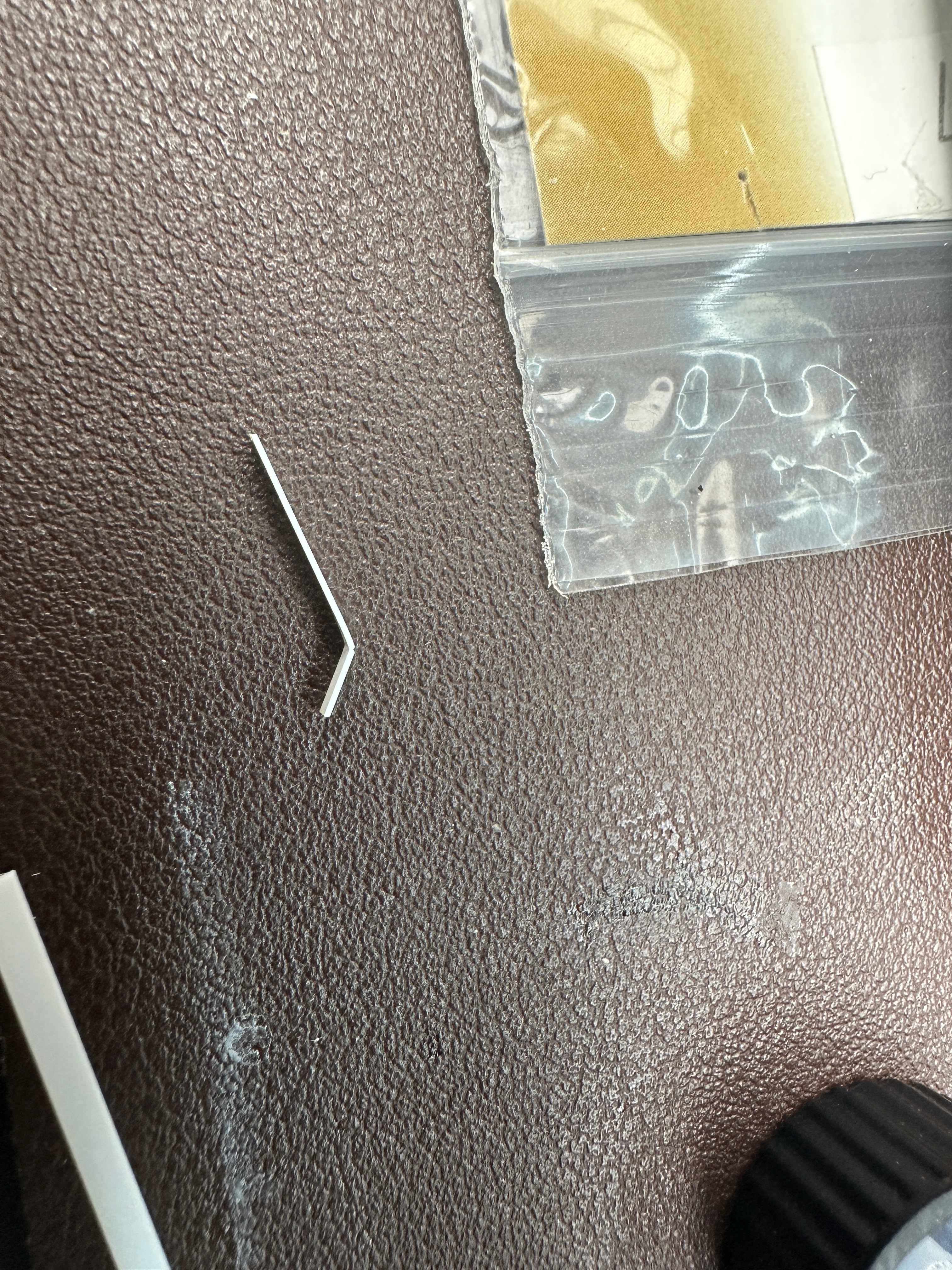
I scored a second piece of 1"x 8" styrene so I could bend it to make a handle for the other part of the whistle bracket.


You can see how I'm installing it here using styrene cement, and a picture of the prototype behind it. On no. 0967 it's mounted about a foot forward of the cab roof.


On the second unit, no. 0994, it is mounted about three feet forward. you can see the difference in spacing between the two below:


More to come...